
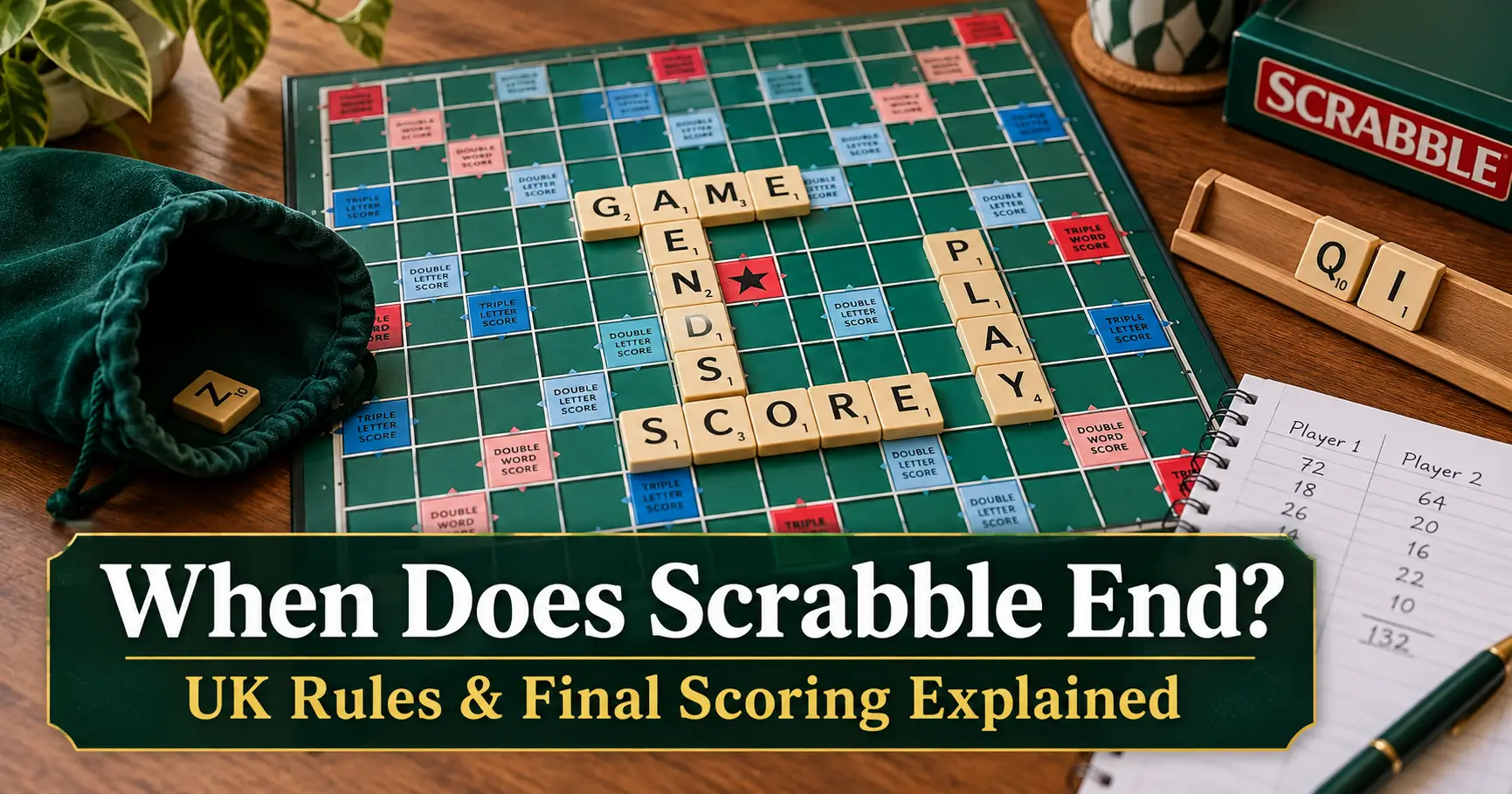
A Scrabble game normally ends when all the tiles have been drawn and one player uses every tile remaining on their rack. The game can also end when no more plays can be made.
However, the exact ending rules depend on whether you are playing a casual home game or competitive Scrabble.
Under Mattel’s UK rules, a game can also finish when all possible plays have been made or when all players pass twice in consecutive turns. Competitive UK Scrabble follows WESPA rules instead, where a game ends after six consecutive zero-scoring turns if nobody plays out.
If you’re trying to use the last few letters on your rack before the game ends, our Scrabble Word Finder can help you explore possible words from the tiles you have.
Understanding the ending matters because the tiles left on each player’s rack can change the final score and sometimes the winner.
When Does Scrabble End? The Quick Answer
There are two main ways a standard Scrabble game can finish:
- The tile bag is empty and a player uses all the tiles on their rack.
- No further play can be made under the rules being used.
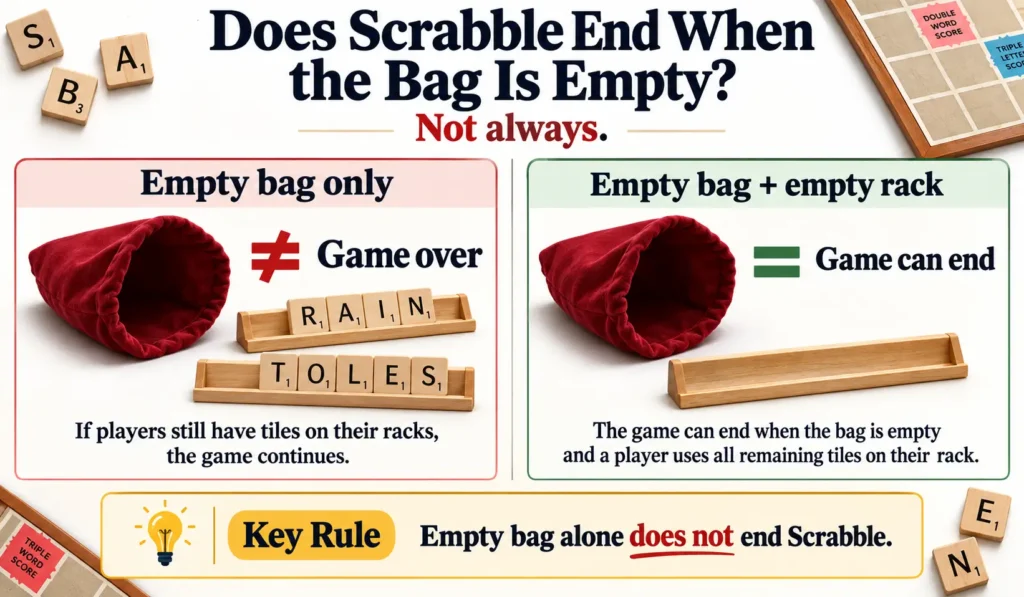
Simply emptying the tile bag does not automatically end the game.
If there are no tiles left to draw but every player still has tiles on their rack, play normally continues until someone goes out or another end-of-game condition is reached.
For UK competitive Scrabble, the rules are more specific. WESPA defines playing out as completing a turn with no tiles remaining on your rack while no tiles remain to be drawn from the bag.
Does Scrabble End When the Tile Bag Is Empty?
No. This is one of the most common misunderstandings about the end of a Scrabble game.
An empty bag means there are no more replacement tiles available, but the players continue playing with the tiles already on their racks. The game can then continue for several more turns.
For a normal play-out ending, two things need to be true:
- The bag is empty.
- One player has used their final rack tile.
Mattel‘s UK Scrabble rules specifically state that the game is over when one player uses all their tiles and the tile bag is empty. So if the final tile is drawn from the bag but everyone still has letters, keep playing.
What Does “Playing Out” Mean in Scrabble?
Playing out means using the final tile or tiles on your rack after the bag has already been emptied. For example, imagine there are no tiles left in the bag.
Your rack contains:
E – R – S
You find a legal place to play all three letters.
After the move:
- your rack is empty;
- there are no tiles in the bag;
- you have played out.
The game can now end.
Under current WESPA rules, this is the formal definition of playing out: after completing a turn, the player has no tiles remaining and there are no tiles left to draw.
What Happens When a Player Uses Their Last Tile?
Once a player legally plays out, the remaining tiles held by the other players affect the final score.
Under the traditional home-game method:
- calculate the value of each player’s leftover tiles;
- subtract those points from that player’s score;
- add the total value of those leftover tiles to the score of the player who went out.
Mattel’s UK rules use this method. This is why the final move can have a much bigger impact than the points scored by the word itself.
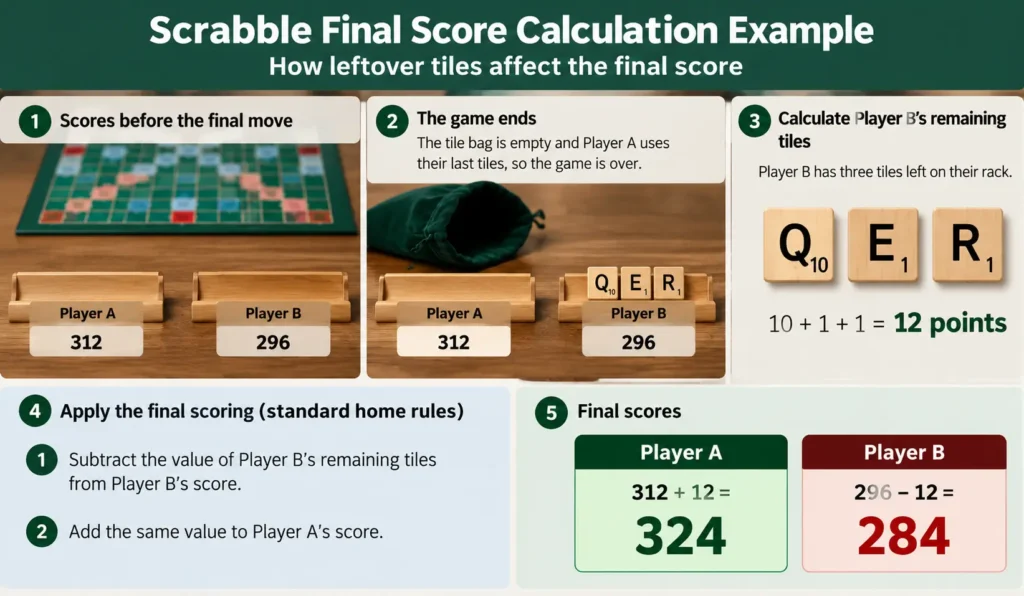
End-of-Game Scoring Example
Suppose the game reaches this position:
Player A: 312 points
Player B: 296 points
The tile bag is empty.
Player A uses the last tiles on their rack and goes out.
Player B is left with:
Q = 10 points
E = 1 point
R = 1 point
Total remaining rack value:
12 points
Using the standard home-game scoring method:
Player B loses 12 points:
296 − 12 = 284
Player A receives those 12 points:
312 + 12 = 324
Final scores:
Player A: 324
Player B: 284
Notice that Player A’s final move did more than simply score the word itself. Going out also produced a 24-point relative swing because 12 points were added to one score and removed from the other. That is one reason endgame planning matters so much.
What If Nobody Can Use All Their Tiles?
Not every Scrabble game finishes with someone playing out. Sometimes the remaining letters are difficult to use. The board may also become so restricted that no legal plays remain.
Mattel’s UK rules allow the game to finish when all possible plays have been made. They also state that the game ends if all players pass twice in consecutive turns.
When nobody goes out, players do not receive their opponents’ remaining tile values. Instead, each player deducts the value of their own unplayed tiles from their score.
What Happens If Everyone Keeps Passing?
This depends on which rules you are using.
1. Casual or home Scrabble
Mattel’s UK rules state that the game can end when all players have passed twice in consecutive turns.
For two players, that means both players repeatedly pass because they cannot—or choose not to—make another move.
2. UK competitive Scrabble
Tournament play is different.
The Association of British Scrabble Players states that ABSP-rated tournaments use the WESPA rules currently in force. WESPA Game Rules version 5.1 has applied from January 2025 onwards.
Under those rules, the game ends after:
- six consecutive turns that score zero points.
That distinction is important. It is not simply a rule about six passes.
What Is the Six Consecutive Zero-Score Rule?
Under WESPA tournament rules, the game ends if there are six consecutive zero-scoring turns.
Those zero scores can result from any combination of:
- passes;
- tile exchanges;
- successful challenges.
After the sixth consecutive zero-scoring turn, the game ends. Each player’s final score is then reduced by the total value of the tiles still on their rack.
For example, a sequence could theoretically look like:
Pass → Exchange → Pass → Successful Challenge → Pass → Pass
If all six turns score zero, the ending condition has been reached. That is why saying “Scrabble ends after six passes” would be inaccurate for competitive UK play. The rule concerns six consecutive zero-scoring turns, not necessarily six passes.
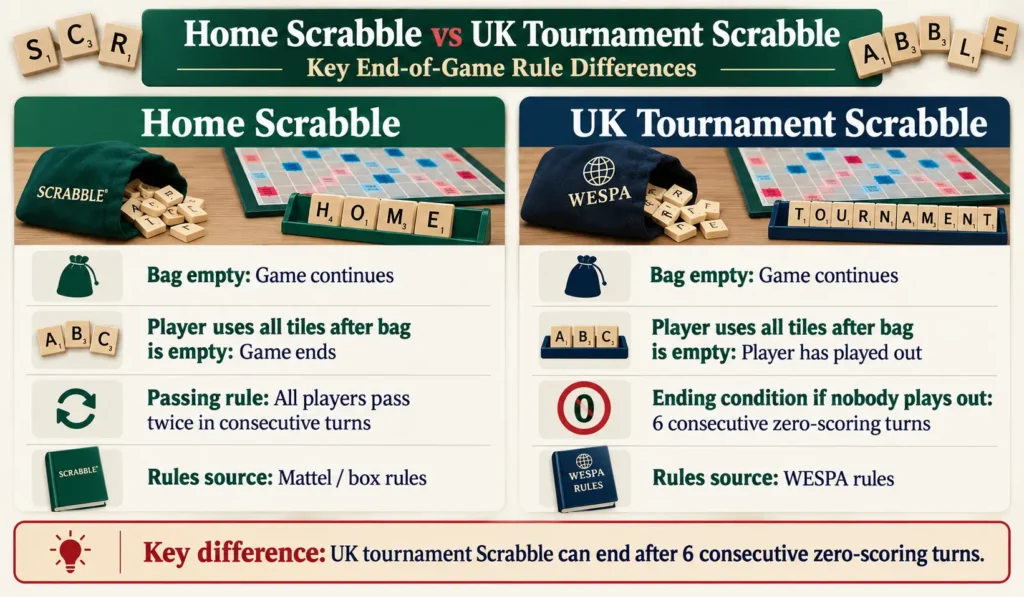
Home Scrabble vs UK Tournament Scrabble
The basic idea is similar, but there are important differences.
| Situation | Home Scrabble | UK Competitive Scrabble |
|---|---|---|
| Bag is empty | Game continues | Game continues |
| Player empties rack after bag is empty | Game ends | Player has played out |
| No further play | Can end the game | Six-zero-score rule applies if nobody plays out |
| Passing rule | All players passing twice can end the game | Six consecutive zero-scoring turns |
| Governing rules | Mattel/box rules | WESPA rules |
| Remaining tiles | Deducted from rack holder | Deducted under WESPA procedure |
ABSP specifically notes that the tournament rules can differ from the rules supplied with the boxed game, and WESPA rules take precedence in ABSP-rated competition.
So if you are playing casually at home, follow the rules supplied with your edition unless everyone agrees on a house rule. If you are playing in a UK-rated event, follow the tournament’s WESPA rules.
How Does WESPA Score the Tiles Left After Someone Goes Out?
Competitive scoring introduces another useful distinction. Current WESPA rules allow two mathematically equivalent approaches when one player plays out.
WESPA’s recommended procedure is to:
- increase the player who went out’s score by twice the value of the opponent’s remaining tiles while leaving the opponent’s recorded score unchanged.
The alternative traditional method is to:
- add the opponent’s remaining tile value to the player who went out and subtract the same amount from the opponent.
Both methods produce the same winning margin.
Example
Player A goes out.
Player B has 12 points remaining.
Traditional calculation:
Player A: +12
Player B: −12
Relative gain:
- 24 points
WESPA’s recommended tournament recording method can instead give Player A:
+24
while leaving Player B’s recorded score unchanged.
The margin is still altered by the same 24 points. For normal home play, using the familiar add-and-deduct method is usually easier to understand.
What Happens to Leftover Blank Tiles?
A blank tile is worth:
0 points
So if you finish the game with a blank still on your rack, it does not create a score deduction.
However, strategically, finishing with an unused blank can represent a missed opportunity because blanks are among the most flexible tiles in Scrabble.
Our Scrabble Strategy Guide explains how tile flexibility and endgame planning affect move selection.
Does a Bingo End the Game?
Not necessarily. A Scrabble bingo means using all seven tiles from your rack in a single turn.
That earns the 50-point bingo bonus. But if there are still tiles available in the bag, you simply draw replacement tiles and the game continues.
A bingo ends the game only if:
- the bag is already empty; and
- the bingo uses every tile remaining on your rack.
For more on seven-tile plays, see our guide to How to Get a Bingo in Scrabble.
Can the Game End With Tiles Still in the Bag?
Usually, playing out cannot occur while tiles remain available to draw because after making your move you would normally replenish your rack. However, the game can finish under a separate no-play or passing condition depending on the rules being followed.
That is why it is better to think of Scrabble as having multiple ending conditions rather than assuming every game must finish because one person empties a rack.
Can Scrabble End in a Tie?
Yes. Two players can finish with the same final score after end-of-game tile adjustments. The rules used for resolving or recording a tie may depend on the edition or competition.
In casual play, you can simply record the game as a tie unless the rules for your edition specify otherwise. In tournament play, follow the competition’s official procedure.
Why the Last Few Tiles Matter So Much
The final stage of a Scrabble game plays differently from the opening and middle game. Earlier in the game, you do not know exactly which letters your opponent holds.
Near the end especially once the bag is empty, you may be able to work out many or all of the remaining tiles.
That information can affect whether you:
- play out immediately;
- block your opponent;
- keep a useful letter;
- unload a high-value tile;
- create a setup for your next move.
Imagine ending the game with:
Q
still on your rack.
That costs 10 points.
If your opponent goes out, those points can also benefit them in the final adjustment. Avoiding a high-value leftover tile can therefore be worth considerably more than squeezing a few extra points from an earlier move.
For detailed move selection and tile tracking, see our Scrabble Strategy Guide.
Common Scrabble End-of-Game Mistakes
1. Thinking the game ends as soon as the bag is empty
It doesn’t. Players normally continue using the tiles already on their racks.
2. Forgetting to deduct leftover tiles
Unplayed rack tiles can change the final result significantly.
3. Forgetting to reward the player who goes out
Under standard home scoring, the player who goes out receives the value of the other players’ leftover tiles.
4. Assuming six passes end every UK tournament game
WESPA’s rule is actually six consecutive zero-scoring turns, which can include passes, exchanges and successful challenges.
5. Mixing home and tournament rules
ABSP-rated tournaments use WESPA rules, which can differ from those supplied with a boxed game.
6. Holding expensive tiles for too long
A Q, Z, J or X left on your rack can become costly when the game ends.
Scrabble End-of-Game FAQs
A standard game normally ends when the tile bag is empty and one player uses all the tiles on their rack. It can also end when no further plays can be made under the rules being used.
No. An empty bag by itself does not end the game. Players continue with the tiles already on their racks until another ending condition is reached.
If no tiles remain in the bag and you use the final tiles on your rack, you play out and the game ends.
The value of unplayed tiles is normally deducted from the score of the player holding them. If another player went out, standard home rules also add the value of those unused tiles to that player’s score.
Under Mattel’s UK home rules, the game can end when all players pass twice in consecutive turns. Competitive WESPA rules instead use six consecutive zero-scoring turns, which may include passes, exchanges and successful challenges.
If you play out after the bag is empty, the remaining value of your opponents’ tiles affects the final score in your favour. This is separate from the 50-point bingo bonus.
No. If tiles remain in the bag, you draw new tiles after the bingo and continue playing.
The game can end without anyone playing out. The exact condition depends on the rules being followed, and players then deduct the value of the tiles remaining on their racks.
Yes. ABSP-rated UK tournaments use current WESPA rules, which include the six-consecutive-zero-scores ending condition.
The End of Scrabble Is More Than an Empty Tile Bag
The simplest rule to remember is:
- Empty bag + empty rack = playing out.
But the empty bag alone does not mean the game is finished. If nobody manages to go out, other ending conditions can apply depending on whether you are using home rules or competitive WESPA rules.
And once the final move is made, don’t forget the tiles left on each rack. Those leftover letters can alter the final score enough to change the winner.
For the complete scoring system, including letter values, premium squares, bingos and final adjustments, read our Scrabble Scoring guide.
If you want to improve the decisions you make during the final few turns not just understand when the game officially ends continue with our Scrabble Strategy Guide.