
A Scrabble bingo can completely change a game.
Using all seven tiles from your rack in a single turn earns a 50-point bonus on top of the normal score for the play. Add a good premium square or a valuable letter and one turn can produce a huge swing on the scoreboard.
But getting more bingos is not simply a matter of being lucky enough to draw seven perfect letters.
Strong players improve their chances through:
- rack management;
- pattern recognition;
- bingo stems;
- prefixes and suffixes;
- blank-tile management;
- board awareness;
- regular seven- and eight-letter word practice.
The basic idea is simple:
RACK → PATTERN → PLACEMENT
First, build a rack with useful combinations. Then recognise a possible word. Finally, make sure there is somewhere on the board to play it.
This guide explains how Scrabble bingos work and how UK players can create more opportunities to find them.
What Is a Bingo in Scrabble?
A bingo happens when you use all seven tiles from your rack in one turn.
You then receive: the normal score of the word or words created + a 50-point bonus
For example, if the word itself scores 24 points, using all seven rack tiles gives you:
24 + 50 = 74 points
Premium squares can make the word portion of the score considerably higher.
If you need a full explanation of Double Letter, Triple Letter, Double Word, Triple Word and scoring order, see our Scrabble Scoring guide.
Does a Scrabble Bingo Have to Be a Seven-Letter Word?
No. This is an important distinction. A bingo is based on how many tiles you use from your rack, not simply the final length of the word.
Seven-letter example
You have seven tiles and place all seven to make a seven-letter word. That is a bingo.
Eight-letter example
There is already one useful letter on the board. You place all seven tiles from your rack around or through that existing letter and form an eight-letter word. You have still used all seven rack tiles, so the play qualifies for the 50-point bingo bonus.
The same principle can apply to an even longer word if all seven of your rack tiles are used as part of the play. This is why experienced players do not search only for seven-letter words. They also look at letters already available on the board.
How Much Is a Scrabble Bingo Worth?
The bingo bonus itself is:
50 points
That is added to the normal score after the word has been calculated. The 50-point bonus itself is not doubled or tripled by a Double Word or Triple Word square.
For example:
Word score after premiums: 42
Bingo bonus: 50
Final turn score:
42 + 50 = 92 points
Because of this extra 50 points, developing bingo opportunities can be one of the most effective ways to increase your average Scrabble score.
Why Bingos Matter So Much
A normal good move might score 20–30 points. A bingo can frequently produce 60, 70, 80 or more points once the 50-point bonus is added.
That means one bingo can:
- turn a close game in your favour;
- erase a substantial deficit;
- create a large lead;
- force your opponent to change strategy.
However, this does not mean you should spend the entire game desperately trying to create one. The strongest bingo strategy improves your bingo chances without sacrificing too many points along the way.
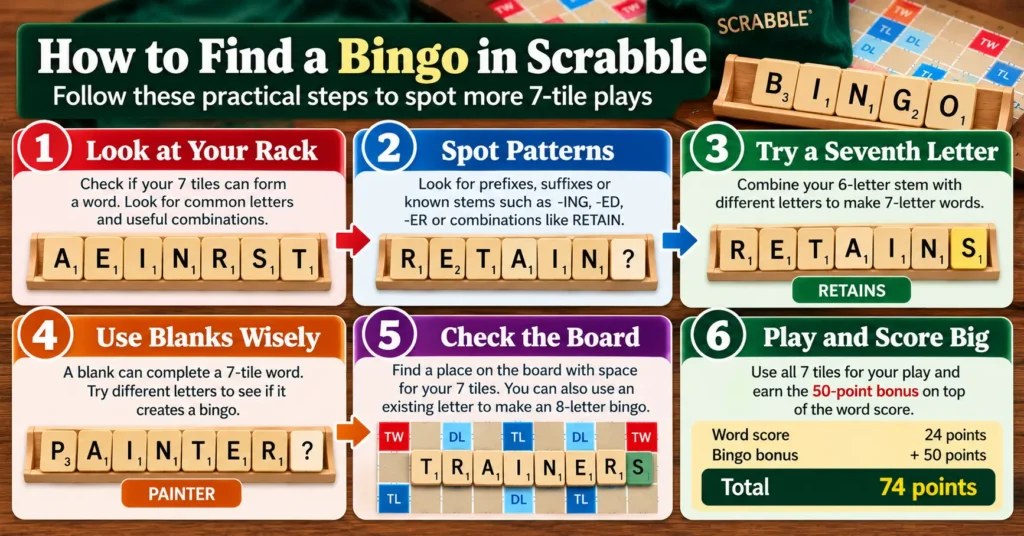
1. Look for a Bingo Before Settling on an Ordinary Move
When your rack looks reasonably flexible, get into the habit of checking for a seven-tile play before choosing a smaller word. You do not need to spend several minutes forcing a bingo out of every rack.
Instead, quickly ask:
Could all seven of these letters form something?
If the rack contains several common letters such as:
A, E, I, N, R, S, T
it deserves a closer look.
If no bingo appears, continue looking for your best normal move. This small habit can prevent you from playing away the exact letter that would have completed a strong seven-letter combination.
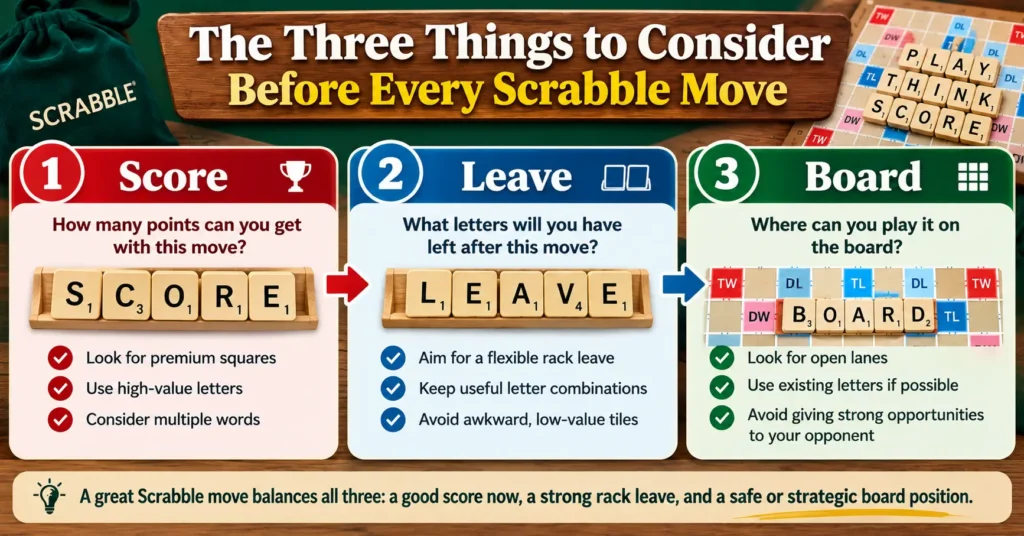
2. Build Better Rack Leaves
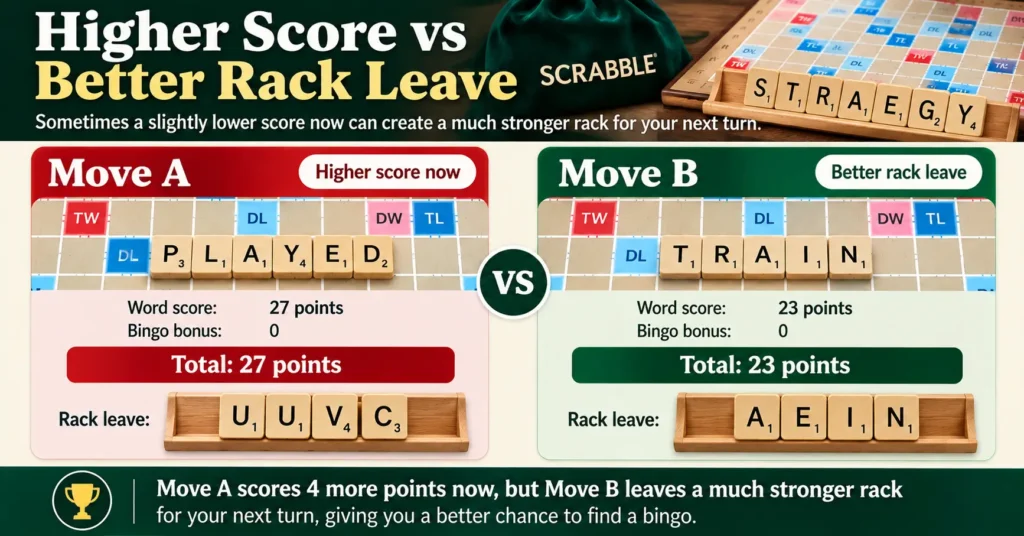
Bingos often begin on the previous turn. Suppose you have two possible moves.
Move A
Scores: 27 points
Leaves: U U V C
Move B
Scores: 23 points
Leaves: A E I N
Move A gives you four more points immediately. But Move B leaves a much more flexible rack.
If the rest of the board position is similar, those four flexible letters may combine far more easily with your next draw. This is why rack leave matters.
You should not automatically sacrifice large numbers of points for a better leave, but when two moves score similarly, consider which letters you will carry into the next turn.
Our full Scrabble Strategy guide explains rack leave and future-turn value in more detail.
3. Learn to Recognise Bingo-Friendly Letters
High-value tiles are not automatically the best tiles for creating bingos. Letters worth only one point are often far more flexible.
For example:
A E I N R S T contains no impressive high-value letters.
But those letters combine extremely well and can form or contribute to many longer words.
Compare that with:
J Q V W X U K
The second rack has much more face value, but finding a seven-letter combination is considerably harder. For bingo-building purposes, flexible letters often matter more than expensive ones.
Useful characteristics include:
- a reasonable mixture of vowels and consonants;
- common letters;
- letters that fit many prefixes and suffixes;
- few awkward duplicates.
4. Learn Six-Letter Bingo Stems
One of the most useful ways to improve your bingo ability is to learn bingo stems. A bingo stem is a group of letters that combines with many different additional letters to create seven-letter words.
Instead of memorising thousands of unrelated seven-letter words, you begin recognising familiar six-letter patterns.
A classic example used in UK Scrabble study is:
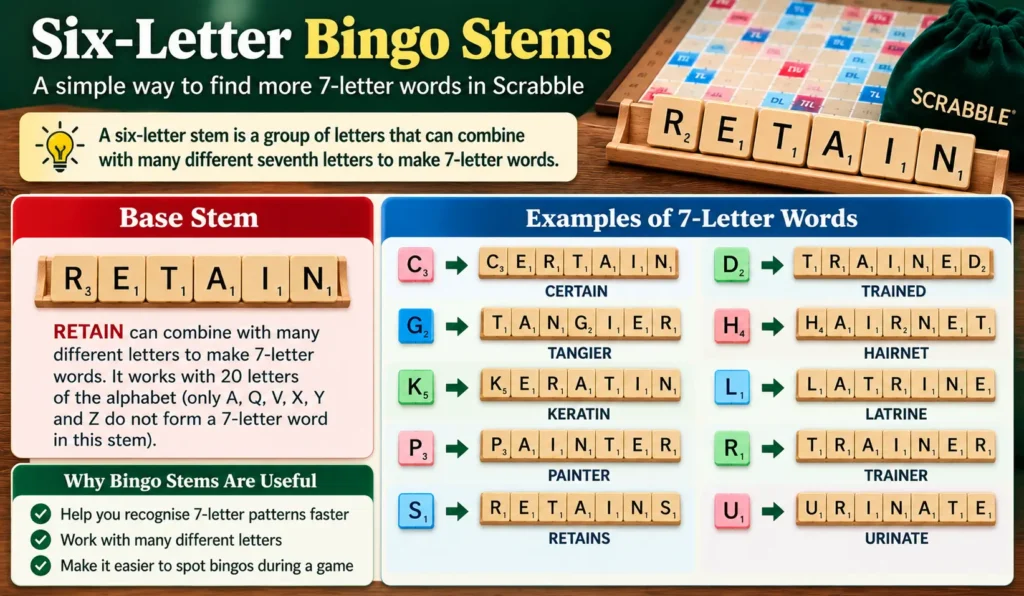
RETAIN
Those six letters can combine with many different seventh letters to make valid seven-letter words.
Examples include:
- RETAIN + C → CERTAIN
- RETAIN + D → TRAINED
- RETAIN + G → TANGIER
- RETAIN + H → HAIRNET
- RETAIN + K → KERATIN
- RETAIN + L → LATRINE
- RETAIN + P → PAINTER
- RETAIN + R → TRAINER
- RETAIN + S → RETAINS
- RETAIN + U → URINATE
The purpose is not to memorise this entire list immediately.
The important skill is recognising:
- “I have RETAIN plus another letter. This rack may contain a bingo.”
Over time, learning several productive stems makes seven-letter patterns much easier to identify.
5. Look for Common Prefixes and Suffixes
You do not always need to mentally unscramble seven random letters at once. Break the rack into familiar pieces.
Look for endings such as:
- -ING
- -ED
- -ER
- -ERS
- -IER
- -S
Then ask what the remaining letters could form.
For example, if your rack contains: I N G
you can temporarily separate those letters and investigate the remaining four.
Likewise, if you spot a likely: -ED ending, you only need to solve the other five letters.
Prefixes can work in the same way. This reduces the number of combinations your brain has to process. Strong anagram recognition is often less about seeing an entire word immediately and more about recognising familiar word structures.
6. Rearrange Your Rack
Do not leave your seven tiles in the same order for the entire turn. Physically rearranging them can reveal patterns your brain did not notice before.
Try:
1. Grouping vowels
Put vowels together and consonants together.
2. Looking for endings
Move likely combinations such as:
- ING
- ED
- ER
to the right-hand side of the rack.
3. Looking for beginnings
Try likely starting combinations on the left.
4. Alphabetical order
Alphabetising the rack can make familiar stems easier to recognise.
5. Random rearrangement
Sometimes simply mixing the tiles again causes a word to become obvious. This may sound basic, but pattern recognition is heavily affected by how letters are visually presented.
7. Use Blank Tiles Carefully
A blank tile is extremely valuable when building bingos because it can represent any letter. Suppose you have six strong letters plus a blank.
Instead of immediately deciding:
- “I’ll make the blank an S.”
systematically test possibilities.
Ask:
- Could it complete a common suffix?
- Could it turn the rack into a known bingo stem?
- Could it create a seven-letter word?
- Could it create an eight-letter word using something already on the board?
A blank is worth zero points by itself, but its flexibility can be worth far more than its face value suggests. That does not mean you should always save blanks. If a blank produces a huge scoring play now, use it.
But avoid spending one cheaply without checking whether a bingo opportunity exists.
8. Don’t Chase a Bingo at Any Cost
This is one of the most important lessons in bingo strategy.
Imagine you have: A E I N R S and one awkward seventh tile.
You recognise that the six-letter group has strong bingo potential.
So you keep it.
Next turn you still cannot bingo.
You keep it again.
Then again.
After several turns you may have scored very little because you were waiting for the “perfect” seventh tile.
That can be poor strategy.
Your objective is not:
- Get a bingo no matter what.
It is:
- Maximise your total score while creating good future opportunities.
If keeping strong bingo letters costs only a few points, it may be sensible. If it requires repeatedly turning down strong scoring plays, the bingo chase may be costing more than it is worth.
9. Look for Seven-Tile Lanes Before You Need Them
Finding a seven-letter word is useless if there is nowhere to put it. Start noticing long open lanes on the board.
Look especially around:
- the centre;
- open rows and columns;
- premium squares;
- words that can accept hooks;
- existing letters that can be incorporated.
If your rack is becoming bingo-friendly, avoid automatically closing every long lane yourself. Sometimes preserving room on the board is strategically valuable. Likewise, if your opponent appears to be building toward a bingo, closing a dangerous lane can be good defence.
10. Look for Eight-Letter Bingos Through Existing Tiles
This is where board awareness becomes particularly valuable. Suppose you cannot make a seven-letter word directly from your rack. That does not necessarily mean there is no bingo.
Look at useful letters already on the board.
Imagine an existing: S
Can your seven rack tiles combine with that S to create an eight-letter word?
Now repeat the question with other accessible letters. You effectively gain an additional letter to work with while still placing all seven tiles from your rack.
Our 8 Letter Word Finder can be especially useful for practising this type of pattern away from live play.
11. Consider Hooks When Searching for Bingo Space
Existing words can sometimes be extended while simultaneously giving you room to place a bingo.
For example, adding:
S
to an existing word may create a new legal word and open an anchor point for your longer play.
Do not look at the board as a collection of occupied and empty squares.
Look for:
- letters you can play through;
- words you can extend;
- hooks;
- crossing opportunities.
This is one reason short-word knowledge and bingo skill reinforce each other.
12. Keep the Board Open When Your Rack Is Strong
If you are holding excellent bingo letters, a completely closed board can become a problem. You may eventually find a seven-letter word but have nowhere to play it.
When the game situation allows it, consider preserving:
- long lanes;
- accessible anchor letters;
- hooks;
- several crossing points.
However, board openness works both ways. An open board also gives your opponent more opportunities.
So always combine bingo planning with the broader principles from our Scrabble Strategy guide. If you are far ahead, protecting the lead may be more important than creating another bingo lane.
13. Learn to Spot Nearly Complete Bingos
Sometimes your rack is only one tile away from becoming much stronger. Suppose you hold six highly compatible letters.
Before playing two or three of them away, ask whether keeping most of the group gives you a good chance of improving on the next draw. This is another reason bingo stems are useful.
Once you recognise common six-letter combinations, you can identify when your rack is “close” to a bingo instead of treating every group of letters as random.
14. Don’t Assume Seven-Letter Words Are Always the Best Move
Finding a bingo is exciting. But the existence of a bingo does not automatically mean you should play it.
Imagine:
Bingo
Scores: 61 points
but opens an enormous Triple Word opportunity.
Alternative play
Scores: 52 points
and blocks your opponent’s strongest lane.
Depending on the score, remaining tiles and board position, the second move could be strategically preferable. Most of the time a bingo is extremely attractive because of the 50-point bonus.
But Scrabble remains a positional game. Evaluate the whole move.
15. Practise Seven-Letter Anagrams Regularly
The fastest way to become better at finding bingos is repeated exposure. Take seven letters and give yourself a short period to find the word.
For example:
A E I N R S T
Try rearranging them.
Try identifying endings.
Try finding stems.
Then check the possibilities.
You are training your brain to recognise letter groups rather than solving each rack from scratch. Even 10–15 minutes of regular practice can make common patterns feel much more familiar over time.
16. Practise Eight-Letter Words With a Fixed Letter
Eight-letter practice is particularly useful because it reflects a common real-board situation.
Take seven rack letters.
Then add one fixed board letter.
For example:
Rack:
A E I N R T ?
Board letter:
S
Now ask:
- What eight-letter words can use that S?
This trains you to look through existing board tiles instead of seeing your rack in isolation.
How to Practise Scrabble Bingos With ScrabbleWordFinder.uk?
Your own games provide some of the best study material. After finishing a game, think back to racks where you suspected there might have been a stronger play.
Use the 7 Letter Word Finder to test seven-letter combinations. If you had an available board letter, use the 8 Letter Word Finder to explore through-letter possibilities.
Then use the Scrabble Word Checker to verify unfamiliar words.
The goal is not simply to discover:
“I missed this word.”
Go further.
Ask:
- What pattern did I fail to recognise?
- Was there an -ING ending?
- Did you overlook a common stem?
- Did you waste a blank?
- Did you play away a useful rack leave?
- Did you have the word but miss the available lane?
That type of review turns missed bingos into useful practice.
Common Scrabble Bingo Mistakes
1. Focusing only on seven-letter words
Remember that an eight-letter word can still be a bingo if you use all seven rack tiles.
2. Holding promising letters for too long
Bingo potential has value, but so do points. Do not sacrifice turn after turn waiting for one perfect draw.
3. Ignoring the board
A word you cannot place has no value during the game. Study the rack and the board together.
4. Automatically using blanks
Always check whether the blank can unlock a bingo before spending it on a small play.
5. Assuming high-value letters are better
Flexible low-value letters frequently combine much more effectively into seven-letter words.
6. Missing common endings
Train yourself to notice patterns such as:
ING, ED, ER, IER and S
instead of treating all seven letters as unrelated.
7. Forgetting rack leave
Your next bingo opportunity may begin with the letters you decide to keep now.
Scrabble Bingo FAQs
A bingo occurs when you use all seven tiles from your rack during a single turn. You receive a 50-point bonus in addition to the normal score of the play.
The bonus is 50 points. That is added to the normal score of the word or words created during the move.
No. You must use all seven tiles from your rack, but the final word can contain more than seven letters if you incorporate letters already on the board.
Yes. If you use all seven rack tiles together with one existing board letter to form an eight-letter word, you still receive the 50-point bonus.
Yes. A blank can represent any required letter. The blank itself remains worth zero points, but it still counts as one of the seven tiles used from your rack.
No. Calculate the word score and applicable premium squares first, then add the 50-point bingo bonus.
A bingo stem is a useful group of letters, often six letters that combines with several possible additional letters to make seven-letter words. Learning productive stems can make bingo recognition much faster.
Flexible common letters such as A, E, I, N, R, S and T often combine well, but there is no single perfect rack. The strength comes from how well the letters work together.
No. Blank tiles are excellent for creating bingos, but a strong immediate scoring opportunity may justify using one earlier. Consider both current score and future potential.
Not automatically. An S is flexible and useful for extending words, but if using it creates a strong move now, holding it purely in hope of a future bingo can be inefficient.
Improve your rack leave, study six-letter stems, practise common prefixes and suffixes, rearrange your rack frequently, learn seven-letter anagrams and pay attention to available board lanes.
Bingos Become Easier When You Learn the Patterns
Scrabble bingos will always involve an element of tile luck. You cannot control what comes out of the bag. But you can control what you do with the tiles you receive.
Remember the three-stage process:
RACK → PATTERN → PLACEMENT
- Build better rack leaves.
- Recognise flexible letter combinations.
- Learn productive bingo stems.
- Look for prefixes and suffixes.
- Use blanks thoughtfully.
- Preserve board space when it benefits you.
- And practise seven- and eight-letter combinations regularly.
- The goal is not to force a bingo every game.
- It is to become better at recognising the opportunities when they appear.
If you want to improve the broader decisions that create those opportunities, read our Scrabble Strategy Guide.
For the exact scoring rules behind the 50-point bonus, see Scrabble Scoring.
And when you want to practise away from competitive play, use our 7 Letter Word Finder, 8 Letter Word Finder and Scrabble Word Checker to study racks, test patterns and expand your Scrabble vocabulary.