When you check a word during a game of Scrabble, you need more than a simple yes or no. You need to know which word list was checked, whether the spelling is accepted in that list, how its tile value is calculated and whether the result applies to the game you’re playing.
That distinction matters. A word can appear in an English dictionary without being accepted in a particular Scrabble word list. Equally, a valid Scrabble word may have no definition available in the reference data used by a word-finding website.
At Scrabble Word Finder Uk, we keep word validity, definitions, letter values and playing examples separate. Each has its own purpose and source of information.
This page explains how our tools process words, how we calculate scores, where our information comes from and what to do if you find a result that needs checking.
1. Our Scrabble Dictionary Sources
Our primary UK Scrabble word list
ScrabbleWordFinder.uk is built primarily for players in the United Kingdom.
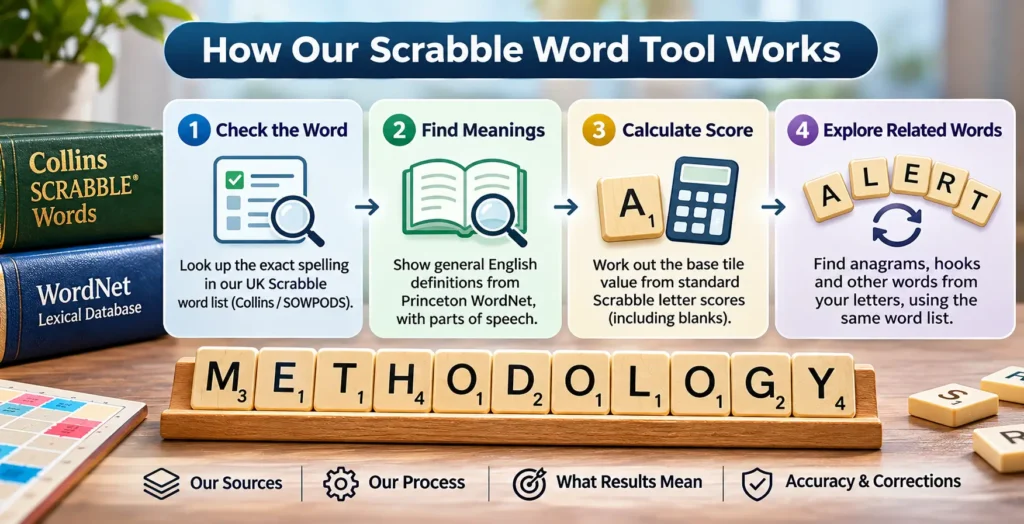
Our UK word-checking system uses an imported word list identified as Collins Scrabble Words, within the SOWPODS/Collins word-list tradition. The configured UK list is the source against which our main Scrabble validity results are checked.
When you look up a word, the system checks whether its exact spelling exists in that installed list. The displayed dictionary name identifies the source being queried.
For reference, Collins Official SCRABBLE Words, Seventh Edition is a published Scrabble word-list reference. Collins states that this edition is endorsed by the World English-Language Scrabble Players Association (WESPA) for tournament and club play from 1 January 2025.
The distinction is important because a dictionary’s name, edition and actual imported contents are not necessarily the same thing.
Other word lists and regional differences
Some words are accepted in one Scrabble dictionary but not another.
UK and international Scrabble use a different word-list tradition from North American Scrabble. Editions also change over time as words are added or removed.
Our platform can maintain separate installed word lists, including UK Scrabble, US Scrabble and other general word-game reference lists.
Where a comparison is available, it is kept separate from the primary UK verdict. Finding a spelling in another installed list does not automatically make it acceptable in UK Scrabble.
For example, the ENABLE word list may be useful for comparing spellings. However, membership in ENABLE alone does not establish that a word is accepted in the current version of Words With Friends.
For casual games, we recommend agreeing on a dictionary before play begins. In organised competition, the organiser’s specified word list and challenge procedure take precedence.
2. How Our Scrabble Word Checker Works
Our Scrabble Word Checker is designed to answer a specific question:
Does this exact spelling appear in the selected Scrabble word list?
The process is based on direct word-list membership, rather than guessing whether something looks like a plausible English word.
Step 1: Reading and standardising the spelling
When you enter a word, the system processes its letters in a consistent format before checking the database.
Uppercase and lowercase letters are treated as the same spelling. For example, entering hello and HELLO does not create two different dictionary entries.
Our dictionary entry system uses continuous A–Z spellings, rather than phrases containing spaces, hyphens or punctuation. The word-entry format supports spellings from two to 32 letters.
This lookup range is not the same as the maximum length of a playable word. A standard Scrabble board is 15 squares across, so a word longer than 15 letters cannot be placed as one continuous word on that board.
Step 2: Checking exact dictionary membership
Once the spelling has been processed, the checker looks for a corresponding entry in the configured dictionary. It does not assume that a spelling is valid simply because a similar word exists.
For example, accepting a base word does not automatically mean that every plural, past tense or other grammatical variation will also be accepted. Each complete spelling must be present in the relevant word list.
Step 3: Understanding the result
There are three important outcomes:
- Valid: The word was found in the configured UK Scrabble list.
- Not valid in this list: The spelling was not found in that list. It may still exist in a general dictionary or another word-game list.
- Check unavailable: The required dictionary could not be checked successfully. This is a technical or configuration problem, not proof that the word is invalid.
We never substitute an unrelated dictionary when the primary UK source is unavailable.
This separation helps prevent a temporary problem with the word database from being mistaken for a genuine negative result.
3. How Our Scrabble Word Finder Generates Results
The Word Finder works differently from a single-word check. Rather than checking just one complete spelling, it searches for words that can be constructed from the letters supplied by the user.
Letter availability and repeated letters
Our search logic takes account of how many times each letter appears.
Suppose your rack contains:
A, E, L, P, P, R, S
You have two P tiles, but only one A, one E, one L, one S and one R. A result must respect those quantities unless blanks or another explicitly selected search mode provide additional possibilities.
A valid dictionary word is not necessarily constructible from your particular rack. The Finder therefore considers both dictionary membership and the available letters. This is especially important when a candidate word contains repeated letters.
Blank tiles
In standard English Scrabble, there are two blank tiles. A blank can represent another letter, but has no letter-point value.
Our Scrabble Word Finder supports blank-tile searches and distinguishes blanks from ordinary printed tiles. When a blank represents a letter, that letter contributes zero points to the tile-value calculation.
A search may find a word because a blank fills a missing letter, but the displayed rack-aware score must account for the blank rather than charging the normal value of the letter it represents.
Search filters and result organisation
Depending on the tool and selected options, you can narrow results by word length, starting letters, ending letters, required letters or spelling patterns.
These filters are applied to the available candidates. They do not automatically add letters to your rack. Results may be arranged by length, alphabetical order or tile score, with larger result sets divided into manageable pages.
The purpose is to make valid candidates easier to explore, not to claim that every result can be placed on the current board. A word can be accepted by the dictionary and still be unusable on a particular turn because of occupied squares, connecting letters or insufficient room.
4. How We Calculate Scrabble Word Scores
Scrabble scoring involves two different questions:
- What are the printed values of the letters in a word?
- How many points would a particular placement score on the board?
Our tools distinguish between these calculations.
Base letter values
For standard English Scrabble, each letter has a fixed printed value.
| Points per tile | Letters |
|---|---|
| 1 | A, E, I, L, N, O, R, S, T, U |
| 2 | D, G |
| 3 | B, C, M, P |
| 4 | F, H, V, W, Y |
| 5 | K |
| 8 | J, X |
| 10 | Q, Z |
| 0 | Blank tiles |
The base word value is calculated by adding those letter values together.
For example, HELLO has a base value of 8 points:
H (4) + E (1) + L (1) + L (1) + O (1) = 8 points.
If one of those L letters is supplied by a blank, the rack-aware letter total becomes 7 points because that blank contributes zero.
The seven-tile bingo bonus
Under standard Scrabble rules, playing all seven rack tiles in one turn earns an additional 50 points. This is commonly called a bingo.
A bingo is determined by the number of tiles placed from the rack, not simply by the length of the completed word.
A seven-letter word constructed partly from letters already on the board does not necessarily earn the bonus. Conversely, a longer completed word may qualify if the player places all seven rack tiles in that move.
Our scoring logic separates the ordinary tile-value calculation from a bingo bonus when sufficient rack information is available.
Why the board score may be different?
A word’s base value is not necessarily its actual move score. Board scoring depends on several factors, including:
- Double-letter and triple-letter squares.
- Double-word and triple-word squares.
- Blank tiles and their zero-point values.
- Letters already on the board.
- Additional words formed by the new placement.
- Whether the placement follows the rules of the game.
For example, placing a high-value letter on a triple-letter square may increase its contribution substantially. If a newly placed tile also forms a perpendicular word, that additional word must be considered as part of the turn.
Premium squares apply when a tile is newly placed on them; they are not repeatedly awarded when the same tile is used in later turns. A simple dictionary lookup cannot know these board conditions.
Important: A base score on a dictionary page should be read as a reference value, not a promise of the points you will earn in an actual game.
Our scoring explanations follow standard English Scrabble principles described in the Mattel Scrabble instructions.
5. Where Our Word Meanings Come From
A Scrabble word checker and an English dictionary serve related but different purposes.
Our main UK Scrabble list establishes whether a spelling appears in the configured game vocabulary. General English definitions are supplied separately.
Princeton WordNet
Our general word meanings come from the Princeton WordNet project, a lexical database developed at Princeton University.
WordNet organises English vocabulary into related sets of meanings, commonly called synsets. These can represent nouns, verbs, adjectives and adverbs. ScrabbleWordFinder.uk uses imported WordNet data to retrieve available meanings associated with a spelling.
Where several senses are available, the system can present more than one meaning and identify the relevant part of speech. This is useful because many English words have different meanings depending on how they are used.
Why a Scrabble word may have no definition
Not every accepted Scrabble spelling appears in the WordNet data installed on our website. Scrabble word lists can include specialised, regional, archaic or less familiar vocabulary that may not have a corresponding WordNet entry.
When a definition is not available, that does not mean the Scrabble validity result is wrong. Similarly, a word appearing in WordNet does not establish that it is accepted in the selected Scrabble dictionary.
Word validity and word meaning are checked independently.
The meanings displayed from WordNet are general lexical explanations. They do not necessarily establish the specific interpretation under which a spelling is acceptable in a game.
Reviewed meaning notes
Some dictionary entries may also include a separately prepared explanatory note.
These notes are distinct from the automatically retrieved WordNet definitions. Our editorial system supports storing a source reference, reviewing a proposed note and publishing it separately from the imported dictionary data.
Where a reviewed note is published, its citation and review information can be displayed with the entry.
We do not present automatically retrieved WordNet senses as though every definition has been individually checked or written by a human editor.
WordNet attribution: Princeton University, WordNet: A Lexical Database for English. Further details are available in WordNet’s citation guidance and licence information.
6. How We Find Anagrams, Hooks and Related Words
Our dictionary pages can also help users explore words connected by spelling or letter arrangement. These relationships are calculated from entries in the selected word list.
Anagrams
An anagram uses the same letters in a different arrangement, without adding or removing letters. For example, LISTEN and SILENT are anagrams because they contain exactly the same letters.
Our anagram matching accounts for repeated letters, so a candidate must have the correct letter quantities.
Front hooks and back hooks
A hook is a letter added to the beginning or end of an existing valid word to create another valid word. Both the starting word and the extended word must be accepted by the relevant word list.
Hooks are particularly useful in Scrabble because they can help a player extend words already on the board. However, finding a valid hook does not establish that a particular board placement is legal.
Words from supplied letters
These are words that can be formed using the available letters without exceeding their quantities. Unlike exact anagrams, a shorter result can leave some letters unused.
Starting, ending and related spelling patterns
We can also identify words that share a starting or ending sequence, words of the same length or other spelling relationships. These are ways to explore the dictionary, not necessarily grammatical or semantic relationships.
For example, two words sharing the same letters at the beginning are not automatically related in meaning.
Suggestions are generated from the underlying word data, with limited previews on individual pages. They should not be mistaken for an exhaustive list when the interface shows only a selection.
7. Playing Notes, Tile Availability and Board Examples
Knowing that a word is valid is only the first part of using it effectively. Some of our word entries include additional observations intended to make their Scrabble information more useful.
These can cover letter quantities, comparisons between possible words, letters remaining from a rack or a particular playing situation.
Understanding tile limitations
A standard English Scrabble set contains 100 tiles, including two blanks. The number of printed tiles varies by letter. For example, there is only one printed Q and one printed Z in the standard set.
That means a word’s dictionary validity does not necessarily tell you whether its letters can all be supplied by printed tiles from your rack.
An existing letter on the board or a blank tile may change what is possible. Our tile observations distinguish between a word’s spelling and the physical tile quantities available in a standard set.
Illustrative playing diagrams
Some entries may include a diagram demonstrating a specific board arrangement.
Our supported reviewed examples are deliberately limited in scope. They can illustrate newly placed letters alongside an existing word, including the additional perpendicular words formed.
The example-validation logic checks the required words against the selected dictionary, calculates the demonstrated score and checks the relevant tile quantities. These diagrams use defined assumptions, such as ordinary scoring squares and no blanks, where stated.
They are not a full simulation of every surrounding board square, and they do not claim to identify the highest-scoring move available in a real game.
A playing example is published through a separate saved and reviewed process. Not every dictionary entry has such an example.
8. How Our Dictionary Pages Are Created
ScrabbleWordFinder.uk uses a custom WordPress-based word platform to provide individual word references, search tools and browsable word lists.
Individual dictionary pages are assembled from information stored in the platform rather than every page being written separately.
Depending on the word and available information, an entry may contain:
- Its membership status in the configured UK list.
- The dictionary name and available edition information.
- Letter count and base tile value.
- Available WordNet meanings.
- Anagrams, hooks and other spelling relationships.
- Additional playing observations or reviewed notes.
- A way to report an incorrect result.
The underlying word data and calculated relationships follow consistent rules across entries. Separately published editorial notes use a different process from automatic word-list lookups.
This distinction matters because a programmatically generated dictionary page does not imply that a human editor has individually reviewed every word, definition or related-word suggestion. Our aim is to make the source and meaning of each result understandable, including where information is incomplete.
9. How Dictionary Updates Are Handled
Scrabble dictionaries change over time. New published editions may include additions, removals or corrections. General English meaning datasets can also change independently.
Our platform stores word-list data and WordNet meaning data separately.
A new Collins publication does not automatically update the UK list installed on ScrabbleWordFinder.uk. Updating the website requires a corresponding dataset import and appropriate verification and for this we have a team of expert.
The platform includes mechanisms for managing imported data, maintaining source information and refreshing or versioning relevant stored results when underlying information changes.
Separately managed editorial notes and playing examples can require renewed checking when their associated source data changes.
We therefore distinguish between:
- The date or edition of a published reference.
- The data currently imported into the website.
- The source details available for that import.
- Any additional editorial material published for an entry.
We do not assume that an imported dictionary is always identical to the newest edition simply because a newer publication exists.
10. What Our Results Can and Cannot Confirm
We want users to understand the limits of a word finder rather than rely on a result beyond what it actually establishes.
Our tools can help establish whether a spelling appears in the configured list, suggest candidate words from supplied letters, calculate letter values and present available definitions.
They do not independently establish that:
- A word can legally be played in every possible board position.
- A general dictionary meaning makes a spelling Scrabble-valid.
- A word accepted by one dictionary is accepted by every edition or other word game.
- A word’s base value is the exact score of a particular move.
- An individual result is an official tournament ruling.
- Every generated word page has been manually reviewed.
These limitations are especially important when comparing word-finding websites.
Two tools may give different answers because they use different datasets, editions or game rules. Before deciding that either result is incorrect, check which source each tool is using. For information, We are using latest sources, editions and datasets.
For tournament or club disputes, always follow the approved reference and challenge procedure for that event.
11. Reporting Incorrect Words, Scores or Definitions
Even carefully developed tools can contain errors, incomplete source information or results that need further investigation. We welcome reports that help identify these issues.
If you find a questionable result, use the Report an incorrect word result option on the relevant dictionary entry, where available. You can report issues such as an incorrect validity result, a missing word, an unexpected score or a definition that appears unsuitable.
Please include the exact spelling and a short explanation of what you believe is wrong.
If the concern involves dictionary validity, identifying the reference and its edition is particularly helpful. For a scoring question, information about blanks, premium squares and crossing words can help distinguish a calculation issue from a difference in board context.
Reports are stored privately for administrative review. Providing an email address is optional. Submitting a report does not automatically change the dictionary or publish a correction. An expert will handle that and solve it as soon as possible.
For other questions about the website, you can contact us through our Contact page.
12. Our Independence and Editorial Responsibility
ScrabbleWordFinder.uk is an independent website created to help users check words, explore spelling patterns and understand Scrabble scoring. We are not the governing body for competitive Scrabble, and our website is not an official tournament adjudication service.
References to Collins, Scrabble, WordNet and other publications are provided to identify relevant word-list traditions, lexical resources and game rules.
They should not be interpreted as an endorsement of this website or as confirmation that a particular imported dataset has been independently certified.
Our responsibility is to explain what our own system checks, distinguish calculated information from editorial material and provide a way for users to question results. We consider those distinctions essential to a useful word-reference tool.
13. Sources and Further Reading
The following references support the methods, terminology and explanations described on this page.
Collins – Official SCRABBLE Words, Seventh Edition
A published reference for accepted Scrabble vocabulary in UK and international play. Useful for understanding the Collins word-list tradition and the edition endorsed for WESPA tournament and club use from January 2025.
Princeton University – WordNet
The lexical database used as the source of available general English meanings on our website.
Princeton WordNet – Citation and Licensing
Information about attribution, permitted use and the licence conditions applicable to WordNet data.
Mattel – Scrabble Game Instructions
Reference rules covering tile quantities, placement, premium squares, scoring and the seven-tile bonus.
These external sources explain the relevant publications and game rules. Linking to them does not independently authenticate our imported word-list files.
Check a Word or Explore the Dictionary
If you want to check a spelling against our configured UK Scrabble list, use our Scrabble Word Checker.
You can also find Scrabble words from your letters or browse our word lists to explore other playable candidates.
Whichever tool you use, remember that the named dictionary, available tiles and actual board position all matter when deciding what you can play.