Knowing more words certainly helps in Scrabble, but vocabulary alone does not make someone a strong player.
Two players can see exactly the same word on the board and make completely different decisions. One may take the highest score immediately. The other may choose a slightly smaller score because it leaves better letters on the rack, blocks a dangerous premium square or creates stronger opportunities for the next turn.
That is where Scrabble strategy begins.
A good move is not simply the longest word you can make or the play worth the most points right now. Strong Scrabble involves balancing your immediate score with your rack, the shape of the board and what your opponent may be able to do next.
This guide explains practical Scrabble strategies for UK players, starting with the fundamentals and progressing into rack leave, bingos, hooks, board control, tile tracking and endgame play.
If you already know the basic rules but want to make better decisions on the board, this is the place to start.
The Three Things to Consider Before Every Scrabble Move
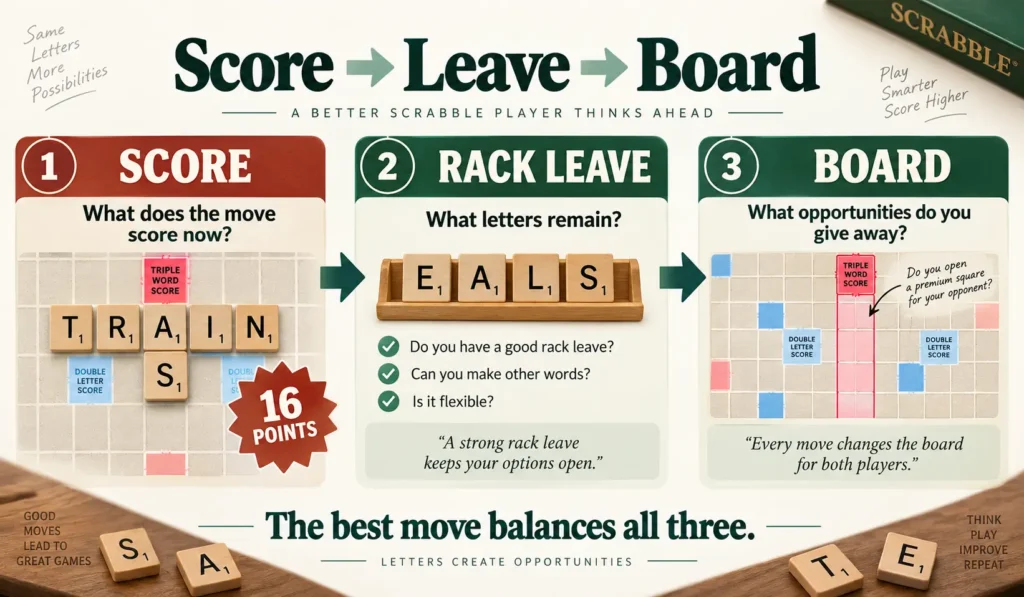
Before placing your tiles, think about three things:
1. What Does the Move Score?
The points you receive now obviously matter. Look for:
- premium squares;
- high-value letters;
- multiple words formed in one move;
- opportunities to use all seven tiles.
But don’t stop there.
2. What Letters Will You Keep?
The letters remaining after your play are called your rack leave. A move that scores 25 points but leaves you with four awkward consonants may be less attractive than a 21-point move that leaves a flexible combination for your next turn.
3. What Does the Move Do to the Board?
Every play changes the opportunities available to both players. Ask:
- Am I opening a Triple Word Score?
- Am I creating an easy hook?
- Am I giving my opponent a clear scoring lane?
- Am I closing an area they were likely to use?
- Does this move make the board more open or more restricted?
A useful way to remember this is:
SCORE → LEAVE → BOARD
Strong Scrabble decisions usually consider all three.
1. Learn the Two-Letter Words First
If you want one piece of Scrabble advice that improves your game quickly, learn the legal two-letter words. They may not look impressive, but they are among the most useful words on the board. Two-letter words allow you to:
- play in tight spaces;
- connect to existing tiles;
- create parallel words;
- reach premium squares;
- get rid of difficult letters;
- score several words with one placement.
For UK and international Scrabble, the short-word vocabulary is broader than many casual players expect. A player who knows the two-letter words can often find scoring opportunities that someone searching only for five-, six- or seven-letter words completely misses.
You do not need to memorise hundreds of obscure words on day one. Start with the shortest legal words and build gradually.
Our dedicated 2 Letter Scrabble Words page is one of the best reference resources to practise from.
2. Build a Useful Short-Word Vocabulary
After two-letter words, focus on three-letter words. Short words are not simply emergency plays. They are strategic tools.
Imagine an area of the board where only three empty squares remain beside another word. A player who knows a wide selection of three-letter words may be able to place a word parallel to the existing one and create several additional cross-words at the same time.
A player searching only for a longer word may see nothing useful there. Short words are especially valuable when you are trying to use letters such as:
J, Q, X and Z
because they allow those expensive tiles to be played in smaller spaces. Learning short vocabulary therefore improves both your scoring ability and your flexibility.
3. Don’t Automatically Play the First Word You See
This is one of the biggest differences between beginner and stronger Scrabble play. Suppose you look at your rack and immediately spot a word worth 26 points. It can be tempting to play it straight away.
But before doing so, ask:
Is there another move?
The first legal word you notice is not necessarily the best move.
Take a few moments to scan:
- different areas of the board;
- premium squares;
- possible hooks;
- parallel plays;
- different ways to use your high-value letters.
Sometimes a shorter word in a better position scores more. Sometimes a slightly lower score creates a much stronger rack. And sometimes your highest-scoring option gives your opponent an easy route to a Triple Word Score.
The habit to develop is simple:
find a move, then look for another move before deciding.
4. Think About Your Rack Leave
Rack leave is one of the most important ideas in Scrabble strategy. It refers to the letters you keep after making a play.
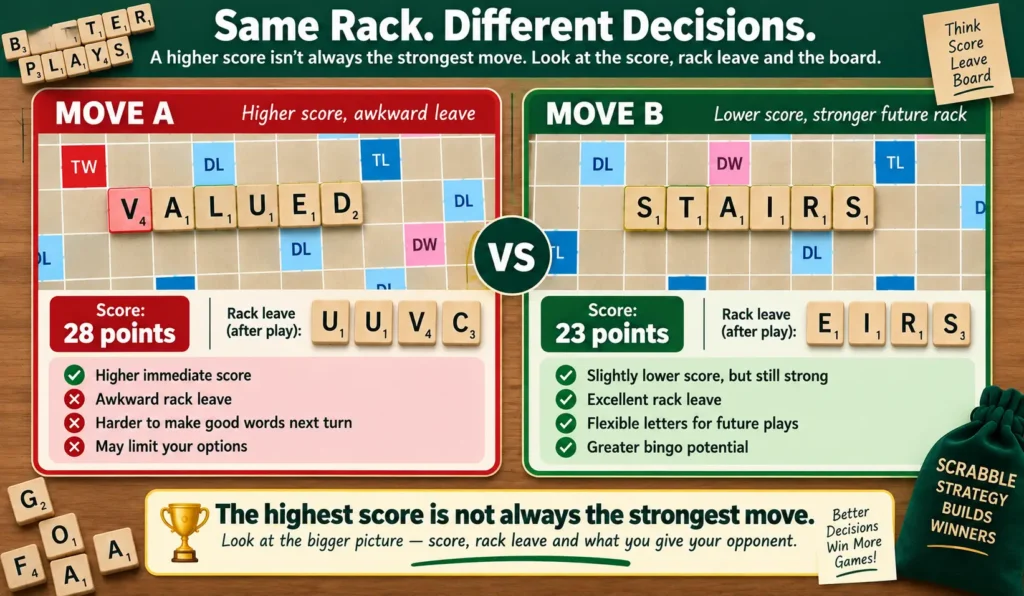
Imagine two possible moves.
Move A
Score: 28 points
Leaves:
U U V C
Move B
Score: 23 points
Leaves:
E I R S
The first move scores five points more immediately. But the second rack is much easier to work with and may give you better scoring and bingo possibilities on the next turn.
That doesn’t automatically make Move B correct. Board position and game situation still matter. The point is that the value of a move does not end when the score is written down. Your remaining letters are part of the decision.
5. Keep Your Rack Flexible
Rack balance is not simply about keeping an exact number of vowels and consonants. There is no rule saying you must always hold three vowels and four consonants. Instead, think about how easily your remaining letters can combine.
A rack containing:
A E I O U E A has plenty of vowels but very little flexibility.
Likewise:
B C D F G V W is heavily overloaded with consonants.
Duplicated letters can also become awkward. Two copies of a useful letter may be fine, but three or four can quickly restrict your options.
When choosing between similar-scoring moves, consider which one leaves you with letters that are more likely to combine productively.
6. Look for a Bingo Before Settling on a Move
A bingo is a play that uses all seven tiles from your rack and earns a 50-point bonus. Because the bonus is so valuable, it is worth checking your rack for bingo possibilities before committing to an ordinary move.
This does not mean spending several minutes trying to force a seven-letter word from every rack. Instead, learn to recognise when your letters look promising.
Flexible combinations containing common letters such as:
A, E, I, N, R, S and T often have strong bingo potential.
High-value letters are exciting, but a rack full of expensive tiles is not necessarily better than one containing versatile one-point letters.
Rack leave matters here too.
If one move scores 30 points but destroys a very promising six-letter combination, while another scores 25 and keeps those letters together, the second move may create a much bigger opportunity on the following turn.
For the scoring mechanics behind a bingo, see our Scrabble Scoring guide.
7. Learn How Hooks Work
A hook is a letter added to the beginning or end of an existing word to create a new valid word. For example, imagine a word on the board can accept an S at the end.
That single tile may allow you to:
- create a new legal word;
- place another word crossing through the S;
- reach a premium square;
- score two words at once.
Hooks are one of the reasons short-word knowledge is so valuable. When looking at the board, don’t only search the empty squares.
Look at the ends of existing words and ask:
Can I add a letter here?
Also look at the beginning of words. A useful hook can turn what looks like a closed area of the board into a strong scoring opportunity.
8. Look for Parallel Plays and Multiple Words
Some of the strongest Scrabble moves do not involve one large word. Instead, they place a word beside another word so that several small cross-words are formed simultaneously. Imagine a four-letter word played parallel to an existing word.
If three of your new tiles each create valid two-letter cross-words, your single move may score:
- the main word;
- cross-word one;
- cross-word two;
- cross-word three.
You receive points for every valid word created. This can make a modest-looking placement surprisingly valuable.
It is also why learning two-letter words has such a large effect on practical Scrabble performance. Our Scrabble Scoring guide explains exactly how multiple words created during one turn are calculated.
9. Use Premium Squares — and Protect Them
Double Letter, Triple Letter, Double Word and Triple Word squares are not only scoring opportunities. They are strategic resources.
Most beginners ask:
How can I reach the Triple Word Score?
Stronger players also ask:
What happens after I use it?
Suppose you score 25 points but place a tile that gives your opponent a clear lane toward a Triple Word Score. If they respond with 50 points, your original move may not look nearly as strong.
That does not mean you should never open premium squares. It means you should consider the opportunity you give away.
This becomes particularly important when you are ahead. Sometimes the safest move is better than the most aggressive one.
10. Don’t Let High-Value Tiles Control Your Rack
Q and Z are worth ten points each. J and X are worth eight. That makes them powerful but also potentially awkward.
A common beginner mistake is holding a high-value tile for several turns because:
“I want to put it on Triple Letter.”
Meanwhile, the tile restricts the rack and prevents better combinations. A Q that remains on your rack for five turns can cost far more opportunities than the extra ten or twenty points you were hoping to gain.
Learn useful short words involving high-value letters and, especially for UK play, expand your knowledge of valid Q words. The goal is not to save expensive tiles forever.
The goal is to use them efficiently. If a strong scoring opportunity appears now, take it rather than waiting indefinitely for the perfect premium square.
11. Treat Blanks and S Tiles as Strategic Assets
Blank tiles are incredibly flexible because they can represent any letter. An S is also valuable because it can often pluralise or extend an existing word while helping form another word at the same time.
But avoid turning this advice into an absolute rule.
You will sometimes hear:
Never waste your S.
or:
Always keep your blank.
Scrabble is too situational for rules like that. If using an S creates a 50-point play, blocks a dangerous lane or allows you to go out at the end of the game, using it may be clearly worthwhile.
The better principle is:
Don’t spend flexible tiles cheaply without considering what they could enable later. A blank that turns an awkward rack into a bingo next turn may be worth preserving.
A blank that allows a huge Triple Word play now may be worth using immediately. Context matters.
12. Know When Exchanging Tiles Is Worth It
Many casual players dislike exchanging because it feels like wasting a turn. Sometimes it is. But sometimes keeping a terrible rack for another turn is even worse.
Imagine a rack overloaded with:
- several copies of the same letter;
- too many vowels;
- too many consonants;
- combinations with very little scoring potential.
If the available plays score almost nothing and leave the underlying problem unchanged, an exchange can improve your future chances.
The decision depends on:
- how bad the rack is;
- how many tiles remain in the bag;
- whether a reasonable scoring play exists;
- your position in the game.
Don’t exchange automatically. But don’t be afraid to exchange when the rack genuinely needs rebuilding.
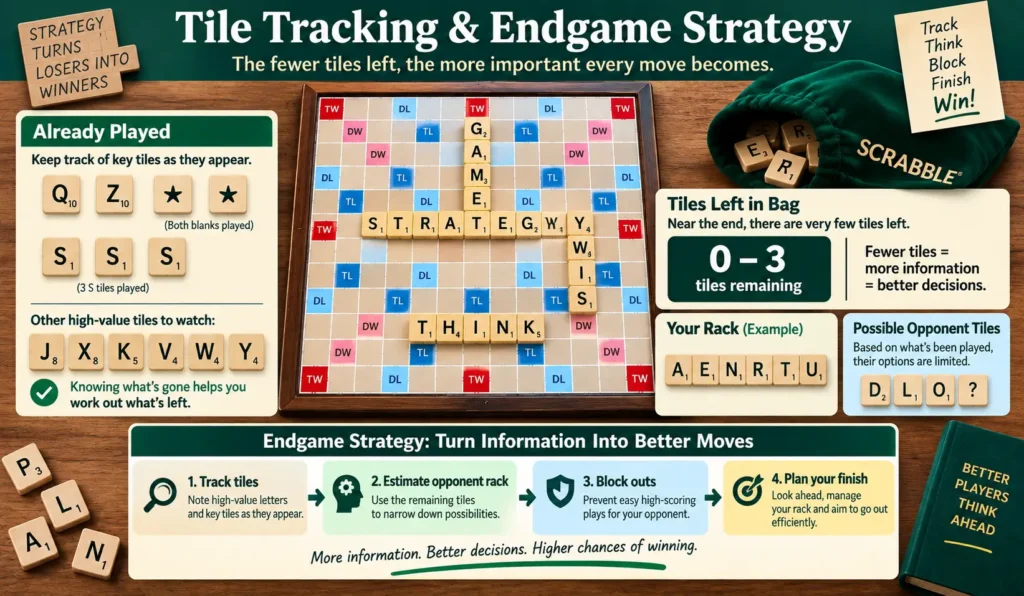
13. Start Tracking Important Tiles
You don’t need tournament-level tile tracking to benefit from paying attention to what has already been played. Start simple.
Notice whether these have appeared:
- Q;
- Z;
- J;
- X;
- blank tiles;
- several S tiles.
Why does this matter?
Suppose both blanks have already appeared. You now know that no blank remains in the bag or on your opponent’s rack.
Or imagine the Q has not appeared late in the game. That information becomes increasingly important because somebody must eventually hold it.
As you improve, you can track more letters. The fewer tiles remaining in the bag, the more valuable this information becomes.
14. Change Your Strategy Depending on Whether You’re Ahead or Behind
Scrabble strategy should change with the score.
When You’re Ahead
You generally have less need to create a chaotic, wide-open board.
Consider:
- closing dangerous bingo lanes;
- avoiding unnecessary Triple Word openings;
- making reliable scoring plays;
- limiting your opponent’s comeback opportunities.
Your objective is not simply to score. It is to protect your advantage while continuing to score efficiently.
When You’re Behind
A very closed board may work against you because there are fewer opportunities to create a large swing. You may need to take more calculated risks.
That can mean:
- opening the board;
- creating new lanes;
- preserving bingo-friendly letters;
- leaving premium-square opportunities available.
This does not mean recklessly handing your opponent a Triple Word Score. It means recognising that a player losing by 70 points may need a different type of game from someone leading by 70.
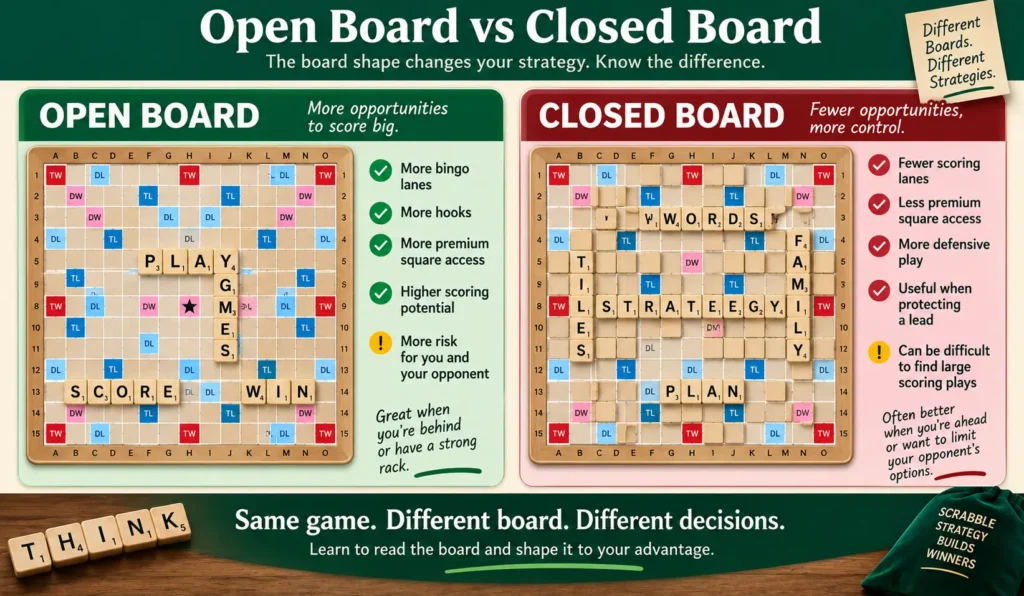
15. Understand Open and Closed Boards
An open board has plenty of:
- hooks;
- accessible premium squares;
- long lanes;
- bingo opportunities;
- crossing points.
A closed board has fewer places where large words can be played. Neither type is automatically good or bad. The right board depends on the game situation.
If you are holding promising bingo letters, an open lane may be exactly what you want. If your opponent is likely to have a powerful rack and you are comfortably ahead, keeping the board restricted may be preferable.
Strong players do not simply react to the board. They help shape it. Every word you play either creates, removes or changes future opportunities.
16. Think About Defence as Well as Attack
Scrabble is not solitaire. The board belongs to both players. A move can score well for you while being even better for your opponent.
Before playing near a premium square, imagine the board after your tiles are placed.
Ask:
What is the easiest strong reply?
If you see an obvious scoring opportunity, your opponent may see it too. Defensive Scrabble doesn’t mean avoiding every open square. It means understanding when the points you gain justify the opportunities you concede.
Sometimes you should take the points.
Sometimes you should block.
That judgment improves with experience.
17. Use Your Opponent’s Plays as Information
Every move tells you something. Suppose your opponent repeatedly plays only two or three tiles. They may be preserving a promising combination.
If they suddenly exchange several tiles, their previous rack was probably poor. If they deliberately close an area of the board despite having another reasonable play, they may be protecting a lead or preventing a lane that particularly benefits your rack.
You should not overanalyse every move, but paying attention makes Scrabble much more strategic. The game contains more information than the seven letters on your own rack.
18. Think Differently Once the Tile Bag Is Nearly Empty
The late game requires a different mindset. Early in the game, you do not know which letters you will draw next. Late in the game, the possibilities become much narrower.
Important questions include:
- Which high-value letters remain unseen?
- How many tiles are left in the bag?
- Can I empty my rack soon?
- Could my opponent go out on the next turn?
- Am I holding a dangerous Q, J, X or Z?
- Can I block the opponent’s likely finishing play?
When only a few tiles remain, thinking one move ahead is no longer enough. You may need to plan several turns.
19. Play the Endgame as a Sequence
Once the bag is empty, no new tiles will enter the game. If you have tracked the remaining letters correctly, you may even be able to work out exactly what your opponent holds.
Now ask:
What happens after this move?
Suppose you can score:
22 points now
but the move leaves one tile that will be extremely difficult to play.
Another option may score:
16 points now
but allow you to empty your rack on the following turn.
The second sequence may be much stronger. Endgame Scrabble is often about going out efficiently, reducing penalties from leftover tiles and preventing your opponent from doing the same.
20. Don’t Confuse Long Words With Good Strategy
Long words look impressive. That doesn’t necessarily make them strong plays. Suppose you can play a six-letter word for 18 points.
Elsewhere, you can play a three-letter word that:
- uses an X;
- hits a Triple Letter Score;
- creates a second cross-word;
- blocks an opponent’s Triple Word lane.
The three-letter word may be far superior. Scrabble rewards placement, not just vocabulary.
Ask:
What does this move accomplish?
rather than:
How long is my word?
21. Use Your Time to Scan the Board in a Consistent Order
Players often stare randomly at the board and hope a word appears. A more systematic approach is better.
Try scanning in this order:
1. Premium squares
Can you reach a high-value square?
2. Hooks
Can an existing word take a letter at either end?
3. Parallel opportunities
Can you play alongside an existing word?
4. High-value tiles
Can Q, J, X or Z be used efficiently?
5. Bingo lanes
Is there room for a seven-letter play?
6. Defensive threats
What strong reply would your move create?
Having a routine reduces the chance that you overlook an obvious scoring opportunity.
This guide is written with UK/international Scrabble in mind, where the current Collins Official Scrabble Words list is endorsed by WESPA for tournament and club play and contains more than 280,000 permissible words.
A Simple Scrabble Strategy Checklist
Before committing to a move, ask yourself:
Score
- Is this one of my best scoring options?
- Can I use a premium square?
- Can I create more than one word?
Rack
- What letters will I keep?
- Am I leaving too many vowels or consonants?
- Does my leave have good future potential?
- Am I unnecessarily holding an awkward high-value tile?
Board
- Am I opening a dangerous premium square?
- Can my opponent make an easy hook?
- Am I creating or closing a bingo lane?
- Would a different placement be safer?
Game situation
- Am I ahead or behind?
- How many tiles remain?
- Should I be playing aggressively or reducing risk?
You will not need to consciously answer every question forever. With experience, many of these checks become automatic.
How to Practise Scrabble Strategy?
One of the best ways to improve is to analyse your rack after a game.
Suppose you remember having:
A E I N R S T
but you could not find a strong play.
Enter those letters into our Scrabble Word Finder afterwards and compare the available words with what you actually played.
Don’t just ask:
What word did I miss?
Also ask:
- Which move would have left the strongest rack?
- Which placement would have scored more?
- Did I miss a hook or parallel play?
- Did I open a premium square unnecessarily?
This turns a word finder into a learning tool rather than simply a way of generating words.
You can also use the Scrabble Word Checker when you encounter an unfamiliar word and want to confirm whether it is accepted in your chosen word list.
Practising this way gradually expands both your vocabulary and your board awareness.
Scrabble Strategy FAQs
There is no single strategy that works in every position. Strong play usually balances three things: your immediate score, the letters left on your rack and the opportunities your move creates for your opponent.
No. A slightly lower-scoring move may be stronger if it leaves better letters, blocks an opponent’s premium-square access or creates better opportunities for your next turn. Always compare the complete position rather than score alone.
Start with legal two-letter words, then expand into useful three-letter words and short words containing difficult letters such as Q, J, X and Z. Short vocabulary gives you far more placement options on crowded boards.
Rack leave refers to the tiles remaining on your rack after you make a play. Good rack leave improves your chances of having useful combinations on the next turn.
Neither is automatically better. The aim is to keep a flexible combination that is likely to form useful words. Too many vowels or too many consonants can both make a rack difficult to use.
Consider exchanging when your rack is seriously unbalanced and your available plays score very little without fixing the problem. The decision also depends on how many tiles remain and the current score.
Blanks are strategically valuable because they can represent any letter, but you should not automatically save one at all costs. Use a blank when the immediate value such as completing a bingo or reaching a major scoring opportunity justifies it.
An S can be very useful for hooks and parallel plays, but it should not be saved blindly. If using it creates a strong scoring move, helps you go out or prevents your opponent from scoring heavily, spending it may be the better decision.
Tile tracking means keeping track of letters that have already been played so you can estimate what remains in the bag and on your opponent’s rack. It becomes especially useful late in the game.
Defensive play involves limiting high-value opportunities for your opponent. That may include blocking premium squares, closing bingo lanes and avoiding moves that create easy high-scoring hooks. Good defence still needs to be balanced against your own scoring opportunities.
Play regularly, learn the short words, review missed opportunities after games, improve rack management and practise looking at the whole board rather than only your rack. Understanding why one move is better than another will improve your game faster than simply memorising random long words.
Better Scrabble Starts With Better Decisions
Good Scrabble strategy is not about finding a magical list of words that guarantees a win. It is about consistently making better decisions.
- Learn the short words.
- Compare more than one move.
- Think about your rack leave.
- Use premium squares intelligently.
- Look for hooks and parallel plays.
- Watch what opportunities you give your opponent.
- And when the bag starts to empty, begin thinking several turns ahead.
Most importantly, remember the three questions:
- What does this move score?
- What does it leave on my rack?
- What does it leave on the board?
If you develop the habit of considering score, rack leave and board control together, your Scrabble decisions will become much stronger even before your vocabulary grows.
If you are still learning the fundamentals, start with our How to Play Scrabble guide. For a deeper explanation of premium squares, cross-words and point calculations, read our Scrabble Scoring guide.
And when you want to practise difficult racks away from competitive play, use the Scrabble Word Finder to explore the options you may have missed.
The best Scrabble players do not simply know more words. They make more of the letters and board they are given.