
Scrabble is easy to learn, but there is far more to the game than simply putting a few letters together.
Every turn gives you choices. Do you play your highest-scoring word now, save a useful letter for later, open a premium square for your opponent, or exchange a poor rack and sacrifice the turn? That mix of vocabulary, scoring and strategy is what makes Scrabble so rewarding.
If you are playing for the first time, though, you do not need to worry about advanced tactics yet.
This guide explains how to play Scrabble step by step, including the basic Scrabble rules, setting up the board, forming words, calculating scores, using blank tiles and premium squares, checking valid words and finishing the game.
The rules below are suitable for a normal home game in the UK. Competitive Scrabble has some additional tournament procedures, which we will explain briefly later.
Scrabble Rules
If you want the short version before getting into the details, here is how a standard game works.
| Rule | What You Need to Know |
|---|---|
| Players | Usually 2–4 players |
| Starting tiles | Each player draws 7 tiles |
| Objective | Finish the game with the highest score |
| First word | Must pass through the centre square |
| Direction | Words are played horizontally or vertically, never diagonally |
| Later words | Must connect with letters already on the board |
| Premium squares | Double or triple a letter or word score when first covered |
| Blank tiles | Can represent any letter but are worth 0 points |
| Bingo | Playing all 7 rack tiles in one turn earns a 50-point bonus |
| Your turn | Play a word, exchange tiles or pass |
| Winner | The player with the highest final score |
That is the basic game. Now let’s go through it properly.
What Is the Objective of Scrabble?
The objective of Scrabble is simple: score more points than your opponents by forming words on the board.
Each letter tile has a point value. Common letters such as E, A and T are worth relatively few points, while harder-to-use letters such as Q and Z are worth considerably more.
Your score does not depend only on the word you play. Where you place it matters just as much. A short word positioned across a Triple Word Score can sometimes be worth far more than a longer word played in an ordinary area of the board.
That is why good Scrabble players think about both vocabulary and board position.
What Do You Need to Play Scrabble?
A standard game uses a Scrabble board, a bag of letter tiles and a rack for each player.
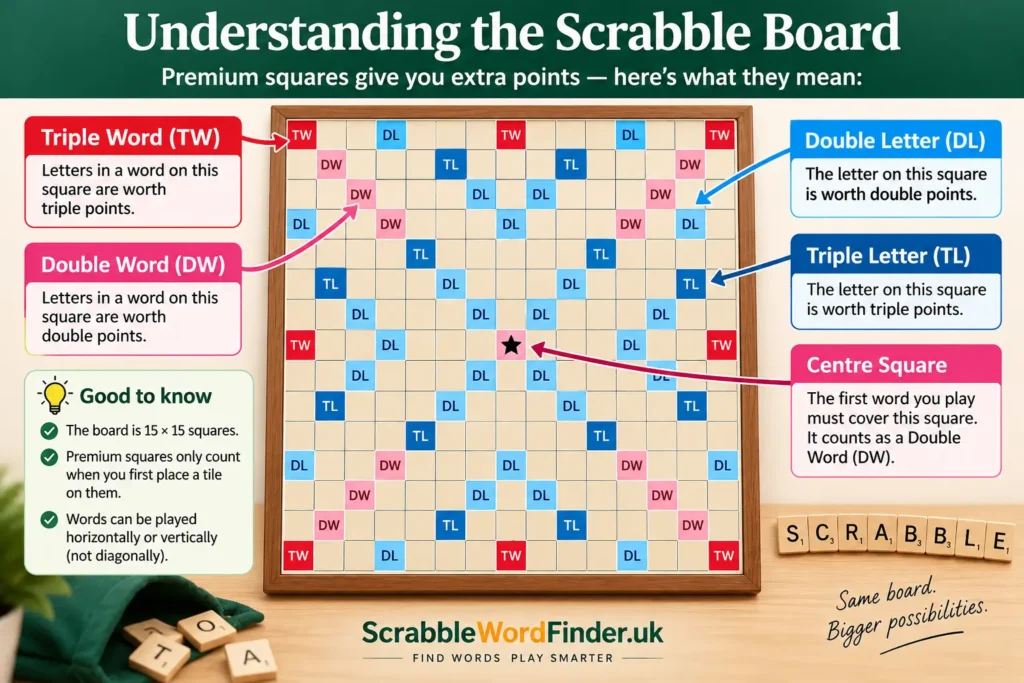
The playing area is a 15 × 15 grid containing normal squares and special premium squares. Players keep their letter tiles on their racks so opponents cannot see them.
At the beginning of the game, each player draws seven tiles. Mattel’s rules describe Scrabble as a game for two, three or four players, with play moving clockwise.
You will also need a way of recording each player’s score.
How to Set Up a Scrabble Game?
Put all of the letter tiles into the bag and mix them thoroughly.
To decide who plays first under the traditional rules, each player draws one tile. The person drawing the letter nearest the beginning of the alphabet goes first, with a blank tile considered before A. Those tiles are then returned to the bag.
Each player draws seven new tiles and places them on their rack without showing them to the other players.
The first player can now begin.
How to Play Scrabble Step by Step?
A Scrabble game develops like a crossword. The first word begins in the centre and each later play must connect to the words already on the board.
1. Play the First Word Through the Centre Square
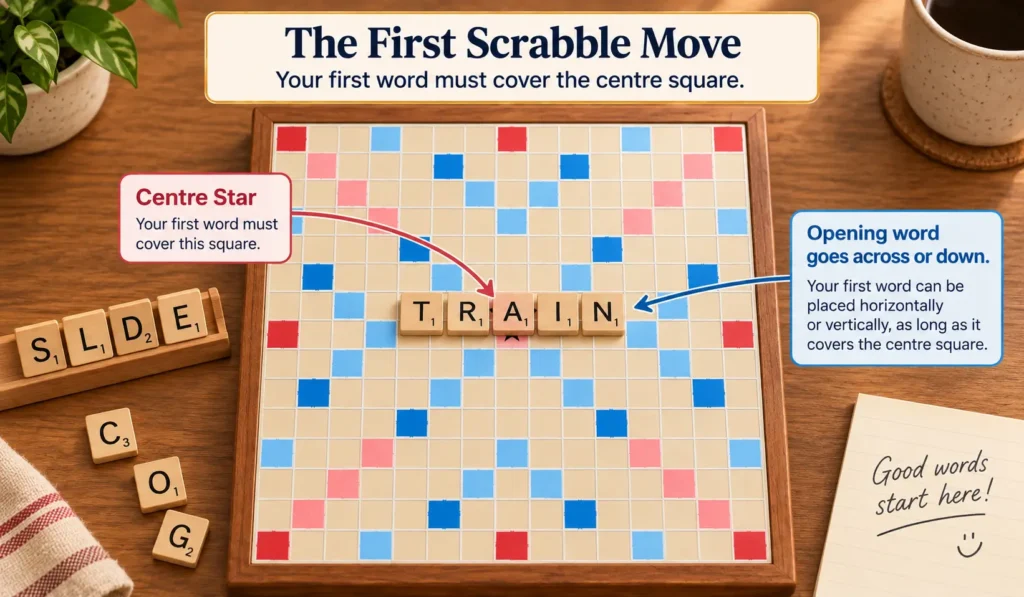
The opening player makes a word using two or more letters from their rack. The word must be placed horizontally or vertically and at least one of its letters must cover the centre star.
You cannot place the first word somewhere else on the board, and Scrabble words cannot be played diagonally. The centre square also functions as a Double Word Score, so the opening word receives that bonus.
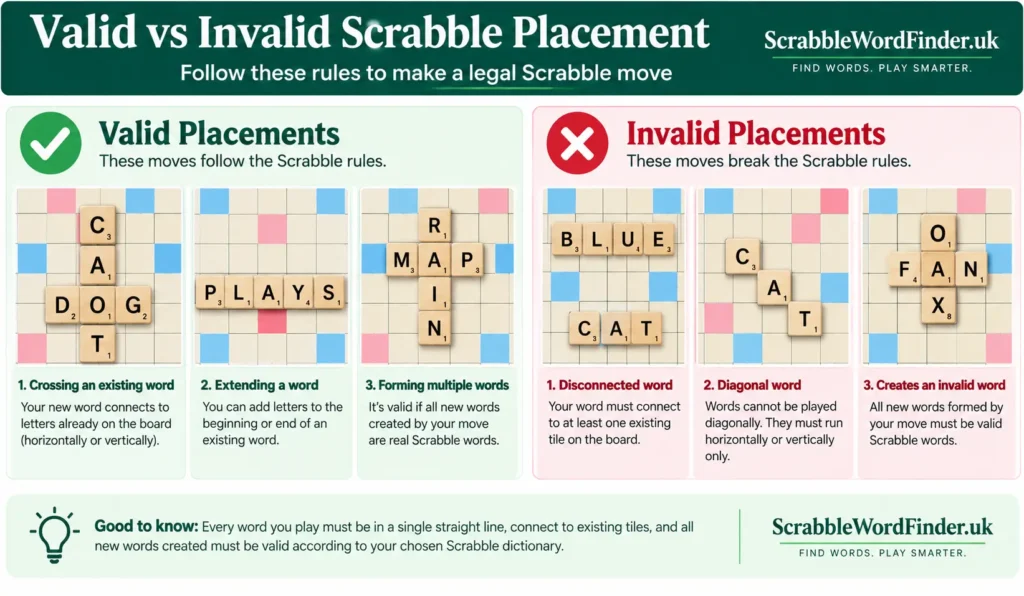
2. Add New Words to the Existing Tiles
The next player must connect their play to something already on the board.
There are several ways to do this. You might cross an existing word, extend a word by adding letters to its beginning or end, or place letters alongside existing tiles so that several words are created at once.
The important rule is that every word created by your move must be valid. For example, you cannot make one valid main word if the same move accidentally creates an invalid two-letter word beside it.
All of the new tiles you place during one turn must also be in a single continuous horizontal or vertical line.
3. Work Out the Score
Add the point values of the letters in every new word formed during your turn.
Then apply any premium squares covered by the new tiles.
If a move creates more than one word, you score all of the words created.
Once your score has been recorded, your turn is complete.
4. Replace the Tiles You Used
After playing a word, draw the same number of tiles from the bag so that your rack returns to seven tiles, provided enough tiles remain.
If you used three tiles, draw three replacements.
This continues until the bag starts to run out near the end of the game.
5. Play Continues Clockwise
The next player takes their turn, followed by the next, and so on.
As the board fills, finding a legal place for your letters becomes more difficult but more opportunities also appear for parallel plays, hooks and high-scoring premium squares.
What Can You Do on Your Turn?
Playing a word is not your only option.
You can also exchange tiles. Instead of making a play, you replace some or all of the tiles on your rack with new ones from the bag. An exchange uses your entire turn, so you score nothing and cannot also play a word.
You may also pass without playing or exchanging anything.
Passing occasionally makes sense late in a game or when you are waiting for the board to open, but repeatedly passing will eventually bring the game to an end under the standard rules.
How Scrabble Scoring Works?
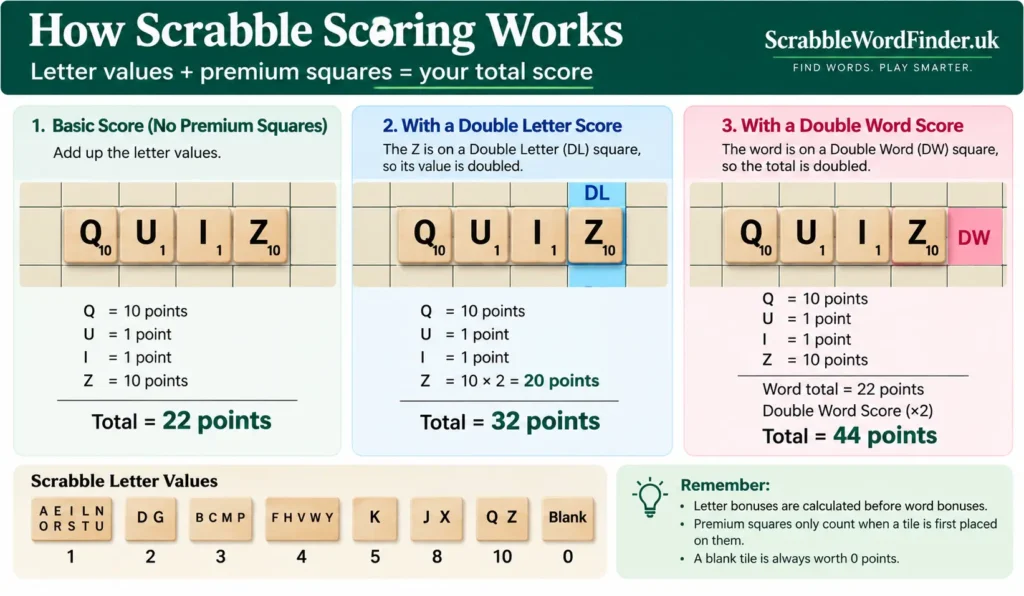
Every letter has a printed point value. Standard English-language tile values are:
| Points | Letters |
|---|---|
| 1 | A, E, I, L, N, O, R, S, T, U |
| 2 | D, G |
| 3 | B, C, M, P |
| 4 | F, H, V, W, Y |
| 5 | K |
| 8 | J, X |
| 10 | Q, Z |
| 0 | Blank tiles |
Suppose you play QUIZ on ordinary squares.
Q is worth 10 points, U is worth 1, I is worth 1 and Z is worth 10. Your basic score would therefore be 22 points.
But premium squares can dramatically change the result.
What Do Double and Triple Squares Mean?
There are four main types of premium square on a Scrabble board.
Double Letter Score
A Double Letter Score (DL) doubles the value of the newly placed letter covering that square. A 10-point Q placed on a Double Letter Score is therefore worth 20 points when calculating that word.
Triple Letter Score
A Triple Letter Score (TL) triples the value of the letter placed there. Put an 8-point X on a Triple Letter Score and that tile contributes 24 points.
Double Word Score
A Double Word Score (DW) doubles the value of the entire word after relevant letter bonuses have been calculated. The centre star used for the opening word is a Double Word Score.
Triple Word Score
A Triple Word Score (TW) triples the complete word score. This is why the high-value squares around the board are so important strategically.
Premium squares only apply when a tile is first placed on them. A letter sitting on a Double Letter Score does not keep receiving that bonus when it becomes part of another word on a later turn.
What Is a Scrabble Bingo?
A bingo happens when you play all seven tiles from your rack in a single turn. You score the normal value of the word or words you create, including any applicable premium squares, and then receive an additional 50 points.
For example, if your play scores 32 points before the bingo bonus, the total score for the turn becomes 82 points.
Bingos can change a game very quickly, which is why experienced players pay close attention to keeping useful combinations of letters on their rack.
You do not need a seven-letter word every time. Existing letters on the board can form part of the final word—the important point is that you use all seven tiles from your own rack during that turn.
How Do Blank Tiles Work?
Blank tiles are among the most flexible tiles in Scrabble.
A blank can represent any letter you choose.
If you need an E to make a word but do not have one, for example, you can use your blank as E.
There are two important rules to remember.
A blank is always worth zero points, regardless of which letter it represents.
Once you have declared what the blank represents, it remains that letter for the rest of the game. You cannot later decide that the same blank represents another letter.
A blank placed on a Double or Triple Letter square still scores zero because the tile itself has no value. However, if the blank is part of a word covering a Double or Triple Word square, the whole word can still receive the word multiplier.
Which Words Are Allowed in Scrabble?
This is one of the most common sources of disagreement during casual games. Under traditional Scrabble rules, players agree before the game which dictionary or word list will be used.
Generally, words that appear only as proper nouns, abbreviations or forms requiring apostrophes or hyphens are not accepted. A word that happens to resemble a name may still be legal if it also has an accepted dictionary meaning as an ordinary word.
This is why guessing based on everyday usage can be misleading. A word may look strange and still be completely valid in Scrabble, while a familiar brand name or personal name may not be playable.
If you are unsure whether a word is accepted, you can use our Scrabble Word Checker to check it against the available word lists.
Which Scrabble Dictionary Is Used in the UK?
This is particularly important for UK players because not every English-language Scrabble game uses exactly the same word list.
The current Official SCRABBLE Words from Collins is the seventh edition published in 2024. Collins states that it contains more than 280,000 permissible words and is endorsed by WESPA for tournament and club use from 1 January 2025.
This international/UK Scrabble vocabulary differs from the North American Scrabble lexicon in some respects.
That means a word accepted in UK or international play is not automatically guaranteed to be accepted under a North American word list and vice versa.
For an ordinary home game, the simplest solution is to agree on your dictionary before you begin. For organised competition, use the word list and rules required by the event.
How Do Word Challenges Work?
In traditional face-to-face Scrabble, another player may challenge a word they believe is invalid.
Under Mattel’s published rules, the challenge occurs before the score is finalised and before the next player’s turn begins. If the challenged word is unacceptable, the tiles are taken back and the player loses that turn.
Challenge procedures can vary between editions, online versions and tournament systems.
For casual play, decide before starting how challenges will work and which dictionary will settle them. This avoids arguments halfway through the game.
For serious UK competitive play, follow the current tournament rules rather than assuming that every detail of a home rulebook applies.
Are UK Tournament Scrabble Rules Different?
Yes, in some areas. The Association of British Scrabble Players states that ABSP-rated tournaments use the WESPA rules currently in force. The current published version is WESPA Game Rules 5.1, used from January 2025 onwards.
The ABSP also specifically notes that tournament rules can differ from the ordinary rules supplied with the boxed game.
If you are simply playing Scrabble at home with family or friends, you do not need to study tournament procedures before your first game. If you begin playing at clubs or competitive events, however, it is worth learning the differences.
When Does a Scrabble Game End?
Under the standard game rules, Scrabble can end when all tiles have been drawn and a player uses the final tiles from their rack.
It can also end when no more possible plays can be made, or after the required sequence of passes specified by the standard rules. Once the game ends, you still need to adjust the scores before declaring the winner.
How Is the Final Scrabble Score Calculated?
- Each player looks at the tiles still left on their rack.
- The point value of those unused tiles is subtracted from that player’s score.
- If one player emptied their rack, that player receives the value of the tiles remaining on the other players’ racks as an additional bonus.
- Imagine you finish with an X and an A still on your rack.
- X is worth 8 points and A is worth 1, so you would lose 9 points from your final score.
- Those final adjustments can decide a close game, which is why holding a Q, Z or other expensive tile late in the game can be risky.
Common Scrabble Rules Beginners Get Wrong
Even people who have played casually for years sometimes use house rules without realising it.
One common mistake is assuming words can be played diagonally. They cannot.
Another is reusing a premium square every time a later word crosses it. Premium bonuses only apply on the turn when a new tile is first placed on that square.
Players also sometimes forget that every new word formed by a move must be valid. If your main word creates two small cross-words, those cross-words count too.
Blank tiles cause confusion as well. A blank does not take on the point value of the letter it represents; it remains worth zero.
And finally, the first word cannot simply be placed anywhere convenient. It must pass through the centre square.
Knowing these details early saves a surprising number of disputes.
Five Simple Tips for Your First Scrabble Game
1. Learn the Short Words
Beginners often search for impressive seven- or eight-letter words while overlooking the value of short ones.
Two- and three-letter words make it much easier to play in tight spaces, create parallel words and reach useful premium squares.
2. Do Not Chase Word Length Alone
A longer word is not automatically a better play. A four-letter word using a valuable tile on a premium square can comfortably outscore a seven-letter word placed badly.
Always compare positions, not just vocabulary.
3. Watch the Premium Squares
Before placing a word, look at what you are leaving available to the next player. Scoring 20 points may not be worthwhile if your move gives an opponent easy access to a Triple Word Score.
4. Keep Your Rack Balanced
A rack containing seven consonants or five copies of similar vowels can be difficult to use. Try to maintain a useful mixture of vowels and consonants when possible rather than simply playing whichever letters score the most immediately.
5. Use a Word Finder for Practice, Not Secretly During Competitive Play
A Scrabble solver is extremely useful when learning.
After a practice game, enter the letters you struggled with into our Scrabble Word Finder and see which words were available. This is a good way to build vocabulary and notice patterns you missed.
During a competitive game, however, outside word-searching tools are normally not permitted. Use them for practice and improvement rather than as hidden assistance during regulated play.
Scrabble Rules FAQs
Each player starts with seven letter tiles. After playing letters, draw replacements so that you return to seven tiles while enough tiles remain in the bag.
Classic Scrabble is normally designed for two to four players.
Yes. The opening word must be played horizontally or vertically with at least one tile covering the centre star. The centre square also acts as a Double Word Score.
No. Words must run horizontally or vertically.
Words used only as proper nouns are generally not allowed under standard rules. However, a word that also has an accepted ordinary dictionary meaning may be valid even if you recognise it as a name.
Yes. You can use your turn to exchange some or all of your rack tiles rather than playing a word. You do not score points on that turn.
Yes. A player can choose to pass rather than placing or exchanging tiles.
A blank tile is worth zero points, no matter which letter it represents.
Using all seven tiles from your rack in a single turn earns a 50-point bonus, usually called a bingo.
No. A premium square applies only when a newly placed tile covers it. Once occupied, it does not provide the same bonus on later turns.
Yes. The standard rules do not prevent the same valid word from being formed more than once in a game.
Once the bag is empty, players continue using the tiles remaining on their racks until the game reaches its ending condition. If a player uses their final tiles, the remaining tile values held by opponents affect the final scores.
Start Playing Scrabble
You now know enough to play a proper game.
Remember the fundamentals: start with seven tiles, put the first word through the centre, connect every later play to the existing board, score every word you create, use premium squares carefully and keep track of the letters left on your rack.
The rules themselves are fairly simple. The real depth of Scrabble comes from learning which words to play, where to place them and which letters to keep for your next turn.
If you want to practise finding playable words from a difficult rack, try the Scrabble Word Finder. And whenever you are unsure whether a particular word is allowed, check it with the Scrabble Word Checker.
The more you play, the less Scrabble feels like a game of simply knowing long words and the more it becomes a game of position, probability, vocabulary and smart decisions.