Scrabble scoring can look simple at first: add up the numbers printed on the letter tiles and write down the total.
In practice, there is a little more to it.
Double Letter and Triple Letter squares can change the value of individual tiles. Double Word and Triple Word squares multiply an entire word. One move can create two or three words at the same time, blank tiles have their own scoring rules, and playing all seven tiles from your rack earns a valuable bingo bonus.
The important part is knowing what to calculate first. Once you understand the correct order, scoring a Scrabble move becomes much easier.
This guide explains exactly how Scrabble scoring works, with clear examples covering letter points, premium squares, multiple words, blank tiles, bingos and final scoring at the end of the game.
Scrabble Scoring at a Glance
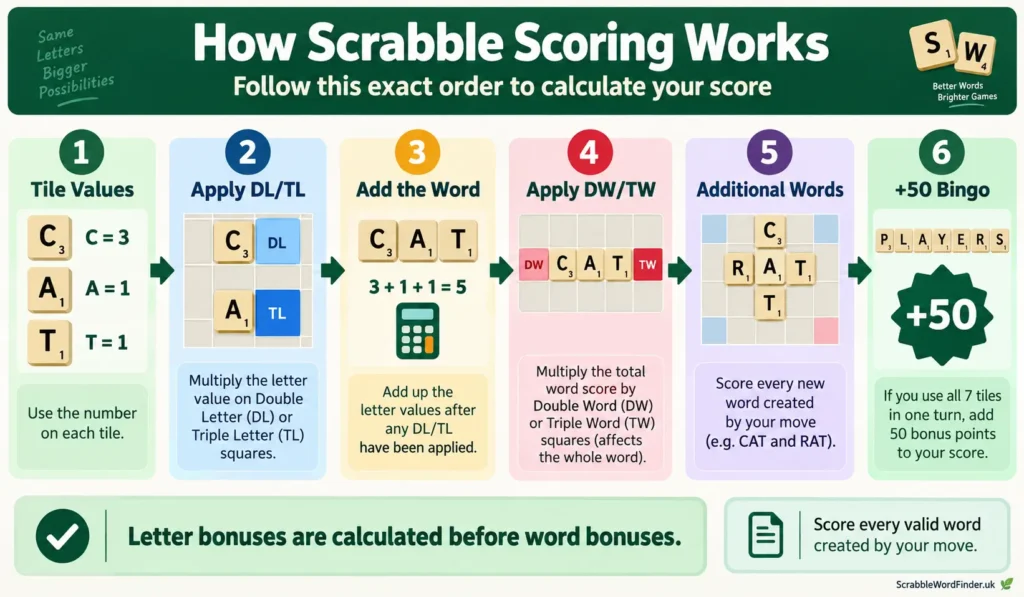
Use this order whenever you calculate a move:
- Add the normal value of each letter in the word.
- Apply any Double Letter or Triple Letter bonuses to newly placed tiles.
- Add those adjusted letter values together.
- Apply any Double Word or Triple Word bonuses.
- Score every additional word created by the same move.
- If you used all seven tiles from your rack, add the 50-point bingo bonus.
- Record the total before the next player begins.
The most important rule to remember is:
Letter bonuses are calculated before word bonuses.
That one detail prevents many common scoring mistakes.
How Are Scrabble Points Calculated?
Every letter tile in Scrabble has a point value based broadly on how common or difficult the letter is to use. Common letters such as A, E and T are worth only one point, while difficult letters such as Q and Z are worth ten.
The standard English-language values are:
| Points | Letters |
|---|---|
| 1 | A, E, I, L, N, O, R, S, T, U |
| 2 | D, G |
| 3 | B, C, M, P |
| 4 | F, H, V, W, Y |
| 5 | K |
| 8 | J, X |
| 10 | Q, Z |
| 0 | Blank tiles |
If your word does not touch any premium squares, scoring it is simply a matter of adding the letter values together.
For example:
QUIZ
Q = 10
U = 1
I = 1
Z = 10
Total = 22 points
The calculation becomes more interesting when one or more newly placed tiles land on premium squares.
Step 1: Add the Value of Every Letter
Start by identifying every letter that forms part of the word you have just made.
This includes:
- tiles you have just placed;
- existing letters already on the board that are now part of your new word.
Suppose the letters form:
GAME
G = 2
A = 1
M = 3
E = 1
The basic word value is:
2 + 1 + 3 + 1 = 7 points
If no new tile is on a premium square, the word scores seven.
But if one of your newly placed letters covers a Double Letter or Triple Letter square, adjust that tile before adding the complete word.
Step 2: Apply Double and Triple Letter Scores
A Double Letter Score (DL) doubles the value of the individual tile placed on it.
A Triple Letter Score (TL) triples that tile’s value.
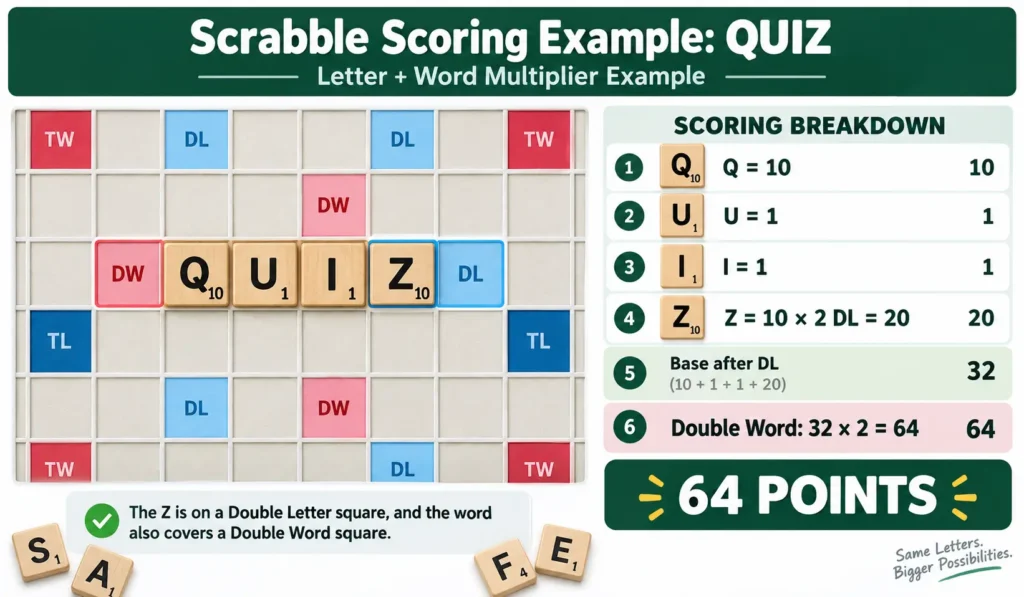
For example, imagine the Z in QUIZ lands on a Double Letter square.
Normally:
Z = 10 points
On DL:
10 × 2 = 20 points
The word would therefore be:
Q = 10
U = 1
I = 1
Z = 20
Total = 32 points
Only the newly placed tile receives the premium.
If a letter was already sitting on a Double Letter or Triple Letter square from an earlier turn, that premium is not activated again when the tile becomes part of a new word.
Step 3: Add the Adjusted Letter Values
Once all applicable letter multipliers have been used, add the letter values together. This gives you the word’s value before any word multiplier is applied.
Using the previous example:
Q = 10
U = 1
I = 1
Z on DL = 20
10 + 1 + 1 + 20 = 32
Now we can apply a Double Word or Triple Word bonus if the move covers one.
Step 4: Apply Double and Triple Word Scores
A Double Word Score (DW) doubles the complete value of the word. A Triple Word Score (TW) triples it.
Imagine our same play of QUIZ has the Z on a Double Letter square and another newly placed tile in the word also covers a Double Word square.
We already calculated the adjusted letter total:
32 points
Now apply the Double Word bonus:
32 × 2 = 64 points
So the complete move scores:
64 points
The correct order is therefore:
letter multiplier first → word multiplier second
Not the other way around.
Worked Example: Letter and Word Bonuses Together
Let’s calculate the move from beginning to end.
Word:
QUIZ
Premium squares:
- Z lands on Double Letter
- The word covers Double Word
Calculate the letters
Q = 10
U = 1
I = 1
Z = 10 × 2 = 20
Letter total:
10 + 1 + 1 + 20 = 32
Apply Double Word
32 × 2 = 64
Final score
64 points
A word that would normally score 22 has nearly tripled because of good board placement. That is why positioning matters so much in Scrabble.
What Happens If a Word Covers More Than One Word Multiplier?
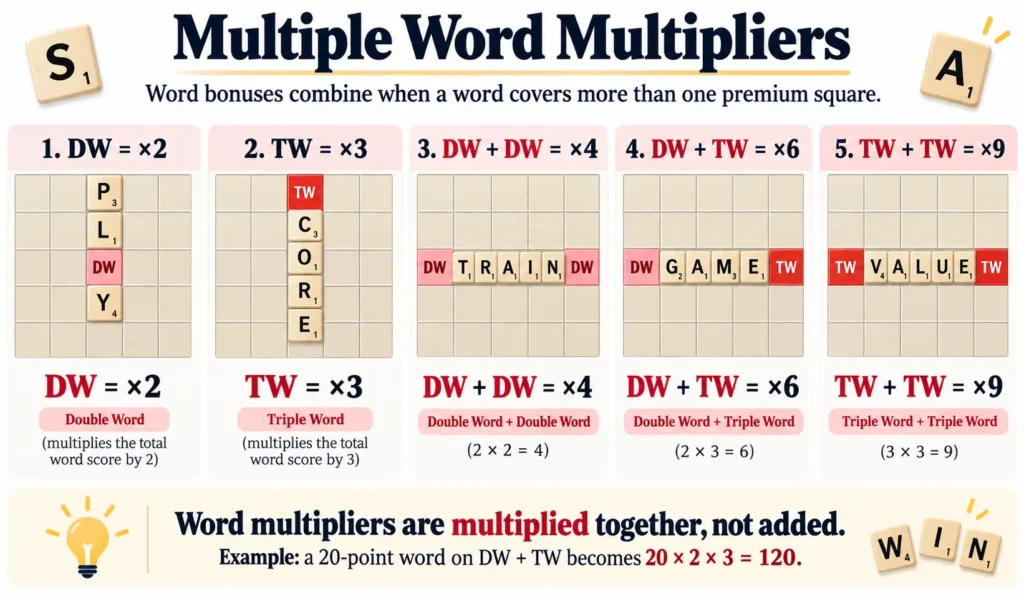
Word multipliers can combine. They are multiplied together rather than simply treated as one bonus.
| Premium squares covered | Final multiplier |
|---|---|
| One Double Word | ×2 |
| One Triple Word | ×3 |
| Two Double Word squares | ×4 |
| Double Word + Triple Word | ×6 |
| Two Triple Word squares | ×9 |
For example, if a word worth 20 points covers two new Double Word squares:
20 × 2 × 2 = 80 points
If the same 20-point word covers both a Double Word and a Triple Word:
20 × 2 × 3 = 120 points
And if it manages to cover two Triple Word squares:
20 × 3 × 3 = 180 points
These opportunities are relatively rare, but they can create enormous scores.
Do Premium Squares Work More Than Once?
No. This is one of the Scrabble rules that beginners most often misunderstand.
A Double Letter, Triple Letter, Double Word or Triple Word bonus only applies when a new tile is first placed on that square. Afterwards, the tile remains on the board but the premium underneath it is considered used.
For example, imagine an A was placed on a Triple Letter square earlier in the game. If you later use that A as part of a new word, the A scores its normal value:
1 point
It does not become three points again. The same applies to Double Word and Triple Word squares.
How Do You Score Multiple Words in One Scrabble Move?
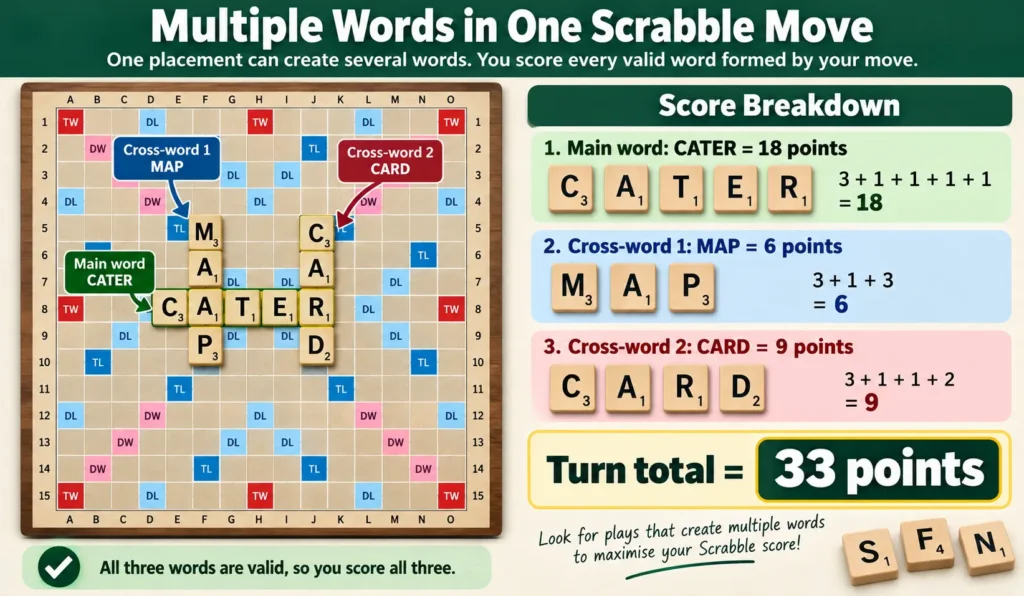
One of the best scoring opportunities in Scrabble occurs when a single placement creates several words at once. You score every valid word created by your move.
Imagine you place several letters horizontally and those new tiles also connect vertically with existing letters.
Your turn might create:
- one main horizontal word;
- two smaller vertical words.
You calculate the score of each word and then add them together.
Example
Suppose your main word scores:
18 points
At the same time, your tiles create two cross-words worth:
6 points and 9 points
Your total score for the turn is:
18 + 6 + 9 = 33 points
This is one reason experienced players often look for parallel plays rather than simply searching for the longest word available.
Can One Premium Square Affect More Than One Word?
Yes, in the right situation. If a newly placed tile sits on a letter-premium square and forms part of two new words, the adjusted value of that tile can contribute to both words.
Similarly, if the newly placed tile covers a word-premium square while forming multiple words, the applicable word bonus may affect the words created through that square according to the scoring rules.
This can make a seemingly small placement surprisingly valuable. The key is that the premium must be activated by a tile placed during the current turn.
How Are Existing Letters on the Board Scored?
Existing letters are still included when calculating the value of a newly formed word.
Suppose an existing Q is already on the board and you add letters to create:
QUIT
The Q still contributes its normal ten points to the new word. However, if that Q was originally played on a Double Letter square, the old DL bonus does not apply again. You count the tile’s face value only.
So:
existing Q = 10
not:
10 × 2 again.
Premium squares belong to the turn on which the covering tile was first played, not permanently to the tile sitting above them.
How Are Blank Tiles Scored?
Blank tiles are extremely useful because they can represent any letter you need. But their scoring value is always:
0 points
If a blank represents a Z, it does not suddenly become worth ten points. It remains worth zero.
1. What if a blank is on Double Letter?
0 × 2 = 0
2. What if a blank is on Triple Letter?
0 × 3 = 0
3. What if a blank activates Double Word?
This is different.
The blank itself remains worth zero, but if the tile is newly placed on a Double Word square, the entire word still receives the Double Word multiplier.
The same principle applies to Triple Word. So a blank can be strategically powerful even though it has no individual point value.
What Is a Scrabble Bingo?
A bingo occurs when you play all seven tiles from your rack during one turn. After calculating the normal score of the play including letter and word premiums, you receive an additional:
- 50 points
Example
Suppose a seven-tile play scores:
34 points
after all premium squares have been applied. Now add the bingo bonus:
34 + 50 = 84 points
Your total for the turn is:
84 points
The important detail is that the 50-point bonus is added after the word itself has been scored. You do not normally multiply the 50-point bonus by a Double Word or Triple Word square.
Why Are Bingos So Valuable?
The obvious advantage is the extra 50 points. But playing a bingo also means replacing seven letters with seven fresh tiles, which can completely reset a difficult rack.
Experienced players therefore pay close attention to letter combinations that make seven-letter plays more likely. Balanced racks containing common vowels, consonants and flexible letters can often be more valuable than a rack filled with individually high-scoring tiles.
How Does Final Scrabble Scoring Work?
Scoring does not necessarily stop when the final word is played. At the end of a standard game, the value of any tiles remaining on a player’s rack is deducted from that player’s score.
For example, if you still have:
X = 8
A = 1
you lose:
9 points
High-value tiles become especially dangerous near the end of the game.
Keeping a Q worth ten points may look useful, but if you cannot play it before the game finishes, it can significantly reduce your final score.
When one player uses all of their tiles, the values remaining on the opponents’ racks are also taken into account under the standard end-of-game scoring rules. This makes endgame tile management an important part of Scrabble strategy.
Common Scrabble Scoring Mistakes
Even regular casual players sometimes calculate moves incorrectly. Here are some of the most common mistakes.
1. Applying Word Bonuses Before Letter Bonuses
- Incorrect: Double the entire word first, then double one letter.
- Correct: Apply DL/TL first, add the letters, then apply DW/TW.
2. Reusing an Old Premium Square
Premium squares do not keep working throughout the game. They apply only when a new tile first covers them.
3. Forgetting to Score Cross-Words
If your move forms three valid words, you score all three. Do not count only the longest word.
4. Giving Blank Tiles a Letter Value
A blank representing Q is still worth:
0 not 10.
5. Multiplying the Bingo Bonus
The 50-point bingo bonus is added after calculating the normal score of the move.
6. Forgetting Existing Letters
Letters already on the board still contribute their normal point value when they become part of a newly formed word. Their old premium squares simply do not reactivate.
Ignoring Multiple Word Multipliers
Two Double Word squares do not result in a single ×2 bonus.
They combine:
×2 ×2 = ×4
A Double Word and Triple Word combine to:
×2 ×3 = ×6
Understanding these combinations can make a major difference to your score.
Is a Longer Word Always Worth More?
No. Word length and word score are two different things.
A seven-letter word played on ordinary squares could score less than a four-letter word using a valuable letter on a Triple Letter square while also reaching a Triple Word square.
For example, placing a Z intelligently can dramatically increase a move even if the word itself is short. That is why strong Scrabble players consider:
- letter value;
- premium squares;
- cross-words;
- rack balance;
- board position;
- what opportunities the move gives their opponent.
Finding a legal word is only the first part of the decision. Finding the best scoring play is where strategy begins.
If you want to explore the words available from your current letters during practice, use our Scrabble Word Finder to compare possible plays and their base scores.
Scrabble Scoring FAQs
Add the values of the letters in every word you form, applying Double and Triple Letter bonuses first. Then apply any Double or Triple Word multipliers. Score all additional words created by the move and add 50 points if you used all seven rack tiles.
The highest-value standard English Scrabble tiles are:
Q and Z = 10 points each
J and X are worth eight points each.
Yes. First adjust the value of the tile on the Double Letter square, then calculate the word total, and finally apply the Double Word multiplier.
The physical premium square itself is only active when first covered. However, if one newly played word reaches two different unused Triple Word squares, both multipliers can apply, resulting in:
×9
Both bonuses apply. The calculation is:
×2 ×2 = ×4
So a 20-point word would score:
80 points
The multipliers combine:
×2 ×3 = ×6
A 20-point word would therefore score:
120 points
No. A blank is always worth zero points, regardless of which letter it represents.
Yes. The blank itself contributes zero points, but the complete word still receives the Double Word bonus if the blank was newly placed on that square.
Yes. If your placement creates a main word and one or more cross-words, every valid word formed during the move is scored.
You receive an additional 50-point bingo bonus after calculating the normal score of the play.
Yes. Existing letters contribute their normal tile value whenever they form part of the new word. Previously used premium squares underneath those letters do not activate again.
Learn to Spot Better-Scoring Plays
Understanding Scrabble scoring changes the way you look at the board. Instead of simply asking:
“What word can I make?”
You start asking:
“Where can I play it for the most points?”
A high-value letter on the right square, a small cross-word, a well-timed bingo or access to two word multipliers can transform an ordinary move into the highest-scoring turn of the game.
If you’re still learning the basic turn sequence and rules, start with our How to Play Scrabble guide before diving deeper into scoring.
When practising, you can also use the Scrabble Word Finder to discover playable words from your rack and the Scrabble Word Checker to confirm whether a word is accepted before adding it to your vocabulary.
The arithmetic behind Scrabble scoring is not difficult once you remember the correct order:
letters → letter bonuses → word total → word bonuses → additional words → bingo bonus
Master that sequence and you will not only calculate scores more accurately, you will start recognising better scoring opportunities before you even place your tiles.
UK tournament note: Competitive Scrabble can use additional procedures beyond normal home-game rules. ABSP-rated tournaments use the WESPA rules currently in force, so competitive players should check the official tournament rules for event-specific scoring and procedures.